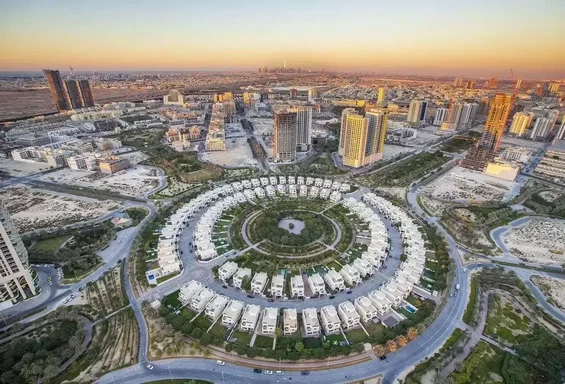
Jumeirah Village Circle attracts investors because it already operates as a large liveable community, not a speculative map point. Nakheel says JVC spans 560 hectares and includes about 95,000 residents, 33 landscaped parks, Circle Mall, over 700 villas, and more than 440 third-party developments that are complete or under construction.
What gives JVC investment appeal
JVC sits in the part of Dubai many buyers view as practical rather than showpiece. That matters. Investors are usually not buying a postcode alone; they are buying tenant depth, day-to-day usability, and the chance that a community keeps improving while people are already living there. JVC checks those boxes because it has a real resident base, built infrastructure, and room for further stock to come online. According to Nakheel, the area is family-friendly, pet-friendly, and built around parks, sports facilities, and retail anchors such as Circle Mall.
Community scale matters more than hype
Many Dubai communities look strong in marketing decks but take time to feel settled on the ground. JVC is different because the scale is already visible. A community with about 95,000 residents behaves differently from a smaller early-stage district. It supports local retail, schools, nurseries, and service businesses in a way that helps both tenants and owners. That resident density is a strong signal for investors who care about repeat rental demand rather than short bursts of interest.
Why tenants keep choosing JVC
JVC works for tenants who want a middle ground. They are not paying for Palm Jumeirah or Downtown Dubai branding, but they are also not stepping into a bare-bones outer district. Nakheel’s own material highlights landscaped parks, sports facilities, villas, and Circle Mall, which helps explain why the area appeals to families, couples, and professionals looking for a more settled daily routine. That tenant mix is useful for investors because it usually supports broader demand across studios, apartments, and larger homes.
Price entry is part of the story, not all of it
JVC has long been discussed as a more accessible alternative to prime Dubai, but the stronger point is not just lower entry price. The stronger point is value relative to lifestyle. Investors usually like areas where tenants can get usable space, parks, and routine services without paying core-prime pricing. Current approved-source pages did not confirm the article’s exact asking-price ranges, so those figures are best left out. The broader investment case still holds because JVC offers scale, mixed housing, and active community infrastructure.
JVC compared with Jumeirah Village Triangle
JVC and Jumeirah Village Triangle are often grouped together, but they are not the same investment play. Nakheel describes Jumeirah Village Triangle as a residential community between Sheikh Mohammed Bin Zayed Road and Al Khail Road with more than 13,000 villas, townhouses, and apartments across 242 hectares. By contrast, JVC’s public positioning is more clearly tied to a dense liveable community with parks, Circle Mall, and a large third-party development pipeline. In simple terms, JVC is usually the more apartment-led, mixed-stock choice, while JVT leans more toward lower-density family housing.
The development pipeline is still a factor
Investors like finished communities, but they also like areas where the story is not over. Nakheel says more than 440 commercial, residential, and hospitality developments in JVC are complete or under construction. That matters for two reasons. First, it shows how much market participation the area attracts. Second, it suggests the community can keep improving its resident experience over time as more stock and services arrive.
The honest drawback investors should weigh
JVC is not a scarcity play in the way Palm Jumeirah or Emirates Hills can be. Its strength is depth, not exclusivity. A large development pipeline helps the area mature, but it can also keep competition high inside the community. That means investors should pay close attention to building quality, service standards, view, parking, layout efficiency, and exact location within JVC. In communities with a lot of comparable stock, the wrong unit can underperform even if the area itself stays active.
Who JVC suits best
JVC suits investors who want a Dubai asset with practical tenant demand rather than pure prestige. It also suits first-time investors who want to enter a recognised master community without starting at ultra-prime price levels. For owner-occupiers, the area fits buyers who value parks, daily services, and a more residential rhythm over headline status.
Want to know the best real estate options in the UAE? Contact us today to inquire!
Contact us via WhatsAppWho may prefer another area
Investors chasing ultra-prime scarcity, branded waterfront living, or a very limited supply story may prefer a different district. Buyers who want a more villa-heavy, lower-density environment may also compare JVC with Jumeirah Village Triangle or other suburban family communities before choosing.
Final verdict
JVC remains attractive because it combines liveability with scale. Nakheel’s official figures show a community that is already large, already active, and still adding development. That is a strong mix for investors. The area is unlikely to win on exclusivity, but it continues to stand out for people who want practical demand, mixed inventory, and a real neighbourhood rather than a thin investment narrative.
FAQ
What makes JVC popular with investors?
JVC appeals to investors because it combines a large resident base with liveable infrastructure. Nakheel says the community has about 95,000 residents, 33 landscaped parks, Circle Mall, and more than 440 third-party developments complete or under construction. That mix supports tenant demand and gives the area more depth than a newly launched district.
Is JVC mainly for families or renters?
It works for both. Nakheel presents JVC as a family-friendly and pet-friendly community with parks, sports facilities, and retail. That makes it useful for families, but it also supports strong day-to-day convenience for renters who want more than a basic apartment cluster.
Does JVC have enough infrastructure for long-term living?
Yes, the official Nakheel material points to a community that already includes parks, Circle Mall, sports facilities, and a large number of completed or active developments. That makes JVC more suited to long-term living than districts that still rely on future infrastructure promises.
Is JVC better than JVT for investment?
They suit different strategies. JVC usually fits buyers who want mixed inventory and a denser, more apartment-led community. JVT, based on Nakheel’s official positioning, is larger in housing count and more oriented toward villas, townhouses, and lower-density family living. The better option depends on the unit type and tenant profile you want.
What is the main risk in JVC?
The main risk is internal competition. JVC benefits from a large development pipeline, but that also means buyers need to be selective. Building quality, layout, view, and service-charge level can make a big difference when several nearby units are competing for the same tenant or buyer.
Is JVC fully built out?
No. That is part of the appeal and part of the risk. Nakheel says more than 440 commercial, residential, and hospitality developments are complete or under construction. Investors who buy well can benefit from a maturing district, but they should also factor in the effect of incoming stock.