Dubai’s market-wide average sale price reached AED 1,976 per square foot in January 2026, based on 16,919 transactions recorded by Dubai Land Department. Five communities are still trading materially below that figure — but the real entry-price advantage in each area is smaller than most comparison articles suggest.
Oplus International Realty tracks this gap using verified DLD transaction data, not listing-price estimates. The difference matters, because several frequently cited “undervalued” areas have already moved significantly since 2024.
What “Below Market” Actually Means in Q1 2026
A property is below market price when its price per square foot is materially lower than the citywide transaction average for comparable stock.
Dubai Land Department recorded an average of AED 1,976 per square foot across all January 2026 residential transactions — an 18% increase year on year from AED 1,674 per square foot in January 2025, based on DLD data aggregated via Dubai Pulse Open Data. Full-year 2025 closed at AED 1,863 per square foot across 215,060 sales worth AED 682.6 billion, according to CBRE UAE’s Q4 2025 review.
That AED 1,976 figure is the correct benchmark. Articles that measure “below market” against AED 1,350 per square foot or lower are using a benchmark that lags the actual market by more than a year — which overstates the discount available in communities that have already appreciated significantly.
Using the verified DLD benchmark, five communities offer meaningful price gaps in Q1 2026. Each has a different reason for that gap, a different appreciation timeline, and a different risk profile.
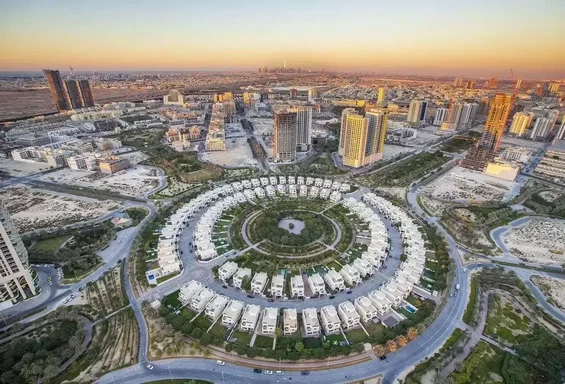
1. Jumeirah Village Circle (JVC) — AED 1,473/sqft
Discount to market: approximately 25% below the January 2026 DLD average.
JVC recorded 1,072 transactions in January 2026 alone, making it the second-most active community by volume after Al Yelayiss 1, based on DLD transaction data via Dubai Pulse. That transaction depth matters: liquidity is the first test of a genuine investment case. A community that is genuinely undervalued but has thin trading volume is difficult to exit when needed.
Why prices remain below the citywide average: JVC is a large, still-delivering master community. New supply continues to complete, keeping per-square-foot prices lower than mature, supply-constrained districts. The community sits on Al Khail Road and Sheikh Mohammed Bin Zayed Road, giving it solid connectivity without the waterfront or DIFC-adjacent premium.
Rental yield context: JVC studios delivered gross yields of 7.87% and one-bedroom apartments 7.04% based on DLD Rental Index data and JLL UAE Q1 2026 benchmarks. That yield at AED 1,473 per square foot is the central reason institutional and retail investors continue to direct capital here.
The honest risk: JVC has one of the highest new-supply pipelines of any Dubai community. An estimated 500 new units completed in Q4 2025 alone competed for the same tenant pool. Investors buying in older buildings with higher service charges and dated amenities face direct pressure from newly handed-over stock. The yield advantage erodes when vacancy gaps run higher than 8%.
Who suits JVC: Investors with a 3–5 year horizon targeting yield with a secondary capital appreciation case. Entry budget typically AED 480,000 to AED 900,000 for apartments.
2. Arjan — AED 1,355/sqft
Discount to market: approximately 31% below the January 2026 DLD average.
Arjan sits inside Dubailand, positioned between Al Barsha and Dubai Hills Estate on Umm Suqeim Road. That location is strategic — it benefits from proximity to two of Dubai’s strongest residential submarkets without yet pricing to their level.
Why prices remain below the citywide average: Arjan’s per-square-foot price has been constrained by the pace of community maturity. Retail, schools, and day-to-day infrastructure developed more slowly than residential stock. That lag is now closing: additional retail nodes and lifestyle facilities opened through 2025, and the area’s proximity to the Dubai Butterfly Garden and Miracle Garden continues to attract families and short-stay renters.
Rental yield context: Arjan delivers gross yields of 7%–8.5%, including strong performance from mid-rise studios and one-bedroom units where entry prices remain accessible. Rental demand is driven primarily by mid-income families and professionals working in the Al Barsha and Dubai Hills corridors.
The honest risk: Arjan’s developer mix is uneven. Not all projects in the community match the quality standards of the better-finished buildings. Investors who choose by community name rather than by specific developer and building quality are taking a wider range of outcomes than the community-level yield average suggests. Research at the project level, not just the area level, is required here.
Who suits Arjan: Investors looking for an affordable mid-market entry with a 5–7 year hold, comfortable with uneven infrastructure maturity and willing to select individual projects carefully. Entry budget from approximately AED 500,000 for studios.
3. Dubailand Residence Complex (DLRC) — AED 650–900/sqft
Discount to market: approximately 55–67% below the January 2026 DLD average — the deepest discount on this list.
DLRC is located near Dubai Silicon Oasis and Academic City on Emirates Road. It remains one of the least well-known communities among international investors, which is both an opportunity and a limitation.
Why prices remain below the citywide average: DLRC has not yet benefited from the infrastructure density or metro connectivity of more established communities. It is car-dependent, which in Dubai’s transit-light outer ring restricts its appeal to a narrower tenant pool — primarily professionals working in Silicon Oasis, Academic City, and Dubailand employment zones.
The Metro Blue Line, currently planned for phased rollout from 2026–2027, includes stations that would materially change DLRC’s accessibility profile if delivered on schedule. That infrastructure trigger is the central investment thesis for this area.
Rental yield context: DLRC delivers gross yields of 7.5%–8.5% based on Ejari rental contract data and DLD benchmarks, supported by steady demand from Academic City and Silicon Oasis professionals. The yield is real because prices are genuinely low — not because rents are particularly high.
The honest risk: The Metro Blue Line timeline is a major uncertainty. Infrastructure projects in Dubai have historically delivered, but phased rollouts carry stage-by-stage delays. An investor buying DLRC on a 3-year timeline may find the metro’s impact on pricing has not yet materialised at the point of exit. Additionally, DLRC’s off-plan pipeline is heavy — multiple project launches through 2026 will create short-term rental competition between new buildings in the same community.
Who suits DLRC: Investors with a 5–7 year minimum hold, tolerance for community immaturity, and a conviction on Metro Blue Line delivery. Entry budget from approximately AED 380,000–450,000 for studios.
4. Dubai South — AED 700–900/sqft (Residential Zones)
Discount to market: approximately 55–65% below the January 2026 DLD average.
Dubai South is a special-purpose master development covering approximately 145 square kilometres near Al Maktoum International Airport. The residential zones sit alongside logistics, aviation, and commercial districts in a phased buildout that began following Expo 2020 Dubai.
Why prices remain below the citywide average: Dubai South is still early in community maturation. Most residential buildings deliver into a submarket with limited retail, school, and healthcare infrastructure relative to the scale of the masterplan. The distance from Dubai’s central employment corridors — approximately 35–40 minutes to DIFC and Business Bay in standard traffic — makes it less competitive for the professional tenant profile that anchors yields elsewhere.
The appreciation case rests on Al Maktoum International Airport expansion. If the airport moves toward full capacity operations — which the Dubai government has confirmed as a long-term priority — Dubai South transforms from a peripheral community into a major employment hub. That is a genuine structural driver. It is also a 10–15 year thesis, not a 3–5 year one.
The honest risk: Dubai South’s price growth of 9%–25% in 2025 (Gulf News, citing market data) has already compresses part of the entry-price advantage that existed in 2023 and 2024. Investors who acted in 2023 have captured the first wave of infrastructure-driven appreciation. Those entering now are pricing in a longer timeline for the airport impact and community maturity — with less price cushion than early buyers had.
Who suits Dubai South: Long-term investors with a 7–10 year horizon who want genuine infrastructure exposure. Not suited for investors expecting 3-year capital returns or requiring immediate rental yield above 7% without active management.
Looking for the perfect property? Contact us now for a free consultation!
Contact us via WhatsApp5. Town Square Dubai — AED 900–1,050/sqft
Discount to market: approximately 47–54% below the January 2026 DLD average.
Town Square is a master community by Nshama, one of Dubai’s established mid-market developers. The community covers over 750 hectares and is positioned on Al Qudra Road in the southern expansion corridor.
Why prices remain below the citywide average: Town Square’s pricing reflects its location and product type: affordable, family-oriented living at distance from central Dubai. The community is functionally complete — with 150,000 square metres of parks, cycling tracks, retail, and cafés — but its distance from prime employment zones constrains the tenant premium that waterfront and DIFC-adjacent communities command.
Rental yield context: Town Square delivers gross yields of 6%–7%, slightly below the communities above. The lower yield percentage reflects the product type — larger units for families generate more stable tenancies but at lower yield percentages relative to studios and one-bedroom apartments in yield-focused districts.
The honest risk: Town Square’s end-user profile is its greatest strength and its greatest pricing constraint simultaneously. Family communities with genuine owner-occupier demand tend to hold value well in downturns but appreciate more slowly in upcycles than investor-heavy communities with higher leverage and turnover. Investors expecting yield performance similar to JVC or DLRC from Town Square will be disappointed.
Who suits Town Square: End-users buying to live in, or investors targeting stable long-term tenancies with families and couples. Not the right choice for investors primarily chasing yield percentage.
The Q1 2026 Demand Driver No Competitor Article Is Mentioning
On 20 February 2026, Dubai Land Department issued a circular removing the previous requirement for Golden Visa applicants to pay 50% of the property value upfront before applying. The new rule requires only that the property is valued at AED 2 million or more — ready, off-plan, or mortgaged.
This change directly increases demand in the AED 2–3 million price bracket and makes the Golden Visa path accessible to a wider range of international investors who previously could not meet the upfront cash threshold. Of the five communities above, JVC, Town Square, and Arjan all have units in the AED 2–3 million range where this rule change is most relevant.
For buyers who need both a yield-generating asset and a Golden Visa pathway, this narrows the effective comparison to communities where units in that price bracket are available and liquid.
A Comparison at a Glance — Q1 2026
| Community | Price/sqft (DLD) | Discount to Market | Gross Yield | Hold Period | Primary Risk |
|---|---|---|---|---|---|
| JVC | AED 1,473 | 25% | 7%–8% | 3–5 years | High supply pipeline |
| Arjan | AED 1,355 | 31% | 7%–8.5% | 5–7 years | Uneven building quality |
| DLRC | AED 650–900 | 55–67% | 7.5%–8.5% | 5–7 years | Metro Blue Line delay risk |
| Dubai South | AED 700–900 | 55–65% | 6.5%–7.5% | 7–10 years | Long appreciation timeline |
| Town Square | AED 900–1,050 | 47–54% | 6%–7% | 5–7 years | Slower upside cycle |
Source: DLD January 2026 transaction data (market average AED 1,976/sqft); area prices from DLD via Dubai Pulse Open Data and CBRE UAE Q4 2025. Gross yield = annual rent ÷ purchase price × 100. Net yield is 1–2 percentage points lower after service charges and management costs.
Oplus Perspective
Across buyer briefs Oplus handled in Q1 2026, the most consistent misalignment was investors pricing Dubai South entry points using data from late 2024. By the time those conversations reached offer stage in Q1 2026, prices in the area had moved 9%–25% depending on the specific project — compressing the entry advantage those investors had planned around.
The same dynamic is beginning in DLRC. Early-mover pricing is no longer available in some projects that launched in late 2024. Investors who treat a community’s Q4 2024 launch price as a proxy for current market entry are underpricing their risk and overpricing their likely return.
The communities with the most intact entry-price advantage as of Q1 2026 are DLRC and Dubai South — but both carry the longest required hold periods. JVC and Arjan offer a more balanced risk-return profile at a shorter horizon, with the trade-off of a shallower discount to market and more direct supply competition.
For a broader read on how yield and capital growth interact across Dubai’s submarkets, Oplus has covered the rental yield vs capital growth dynamics for 2026 in a separate data guide.
Who Should Look at These Communities — and Who Should Not
These five communities suit: Investors with a minimum 3-year hold, a yield-first strategy, and a budget between AED 400,000 and AED 1.5 million per unit. They also suit buyers seeking Golden Visa eligibility at the AED 2 million threshold with assets in mid-market communities rather than prime districts.
These five communities do not suit: Investors who need immediate capital appreciation within 12–18 months, investors prioritising exit liquidity above all else (JVC is the strongest here; Dubai South the weakest), or buyers who want to avoid active management — community immaturity in DLRC and Dubai South increases management intensity.
For investors who want comparable value plays in Abu Dhabi — where Oplus has particular market depth — the Al Reem Island and Khalifa City corridors offer analogous dynamics: established infrastructure, yields of 7%–8%, and entry prices materially below the Abu Dhabi prime submarket average.
Final Assessment
“Below market price” is only useful information if the benchmark is correct. Using the verified DLD figure of AED 1,976 per square foot for January 2026, all five communities above offer real price gaps — ranging from 25% for JVC to 67% for DLRC. Those gaps come with corresponding risk, timeline, and liquidity trade-offs that are part of the same calculation.
The strongest risk-adjusted cases in Q1 2026 are JVC — for investors who want liquidity and a proven yield — and DLRC — for investors with a longer horizon and a conviction on the Metro Blue Line.
Dubai South and Arjan are also genuinely below market, but both require clear-eyed risk acceptance: Dubai South for its timeline, Arjan for its building-level quality variance. Town Square is the most appropriate for end-users and family-tenure landlords rather than yield-focused investors.
For Dubai investment properties listed on the Oplus platform, the team can provide building-level transaction history and service charge data for specific units in each of these communities before any purchase commitment.
Written by: Oplus International Realty Editorial Team
About Oplus: Licensed UAE real estate brokerage based in Abu Dhabi, covering Abu Dhabi and Dubai off-plan, secondary market, and investment properties. RERA registered. oplusrealty.com
Last reviewed: April 22, 2026
Disclaimer: This article is for informational purposes only and does not constitute financial or investment advice. Consult a RERA-licensed professional before any property decision.
Sources: Dubai Land Department — January 2026 residential transaction data via Dubai Pulse Open Data Dubai Land Department — DLD February 2026 circular: Golden Visa upfront payment requirement removed Dubai Land Department — Q1 2026 Rental Market Data (AED 32.2B, 118,385 new contracts) CBRE UAE — Q4 2025 Real Estate Market Review (215,060 transactions, AED 682.6B) JLL UAE — Q1 2026 Yield and Vacancy Benchmarks Knight Frank — Q1 2025 Dubai Residential Market Review (area PSF benchmarks) DLD Rental Index — Area-level rental benchmarks Q1 2026
FAQ
What is the Dubai property market average price per sqft in 2026?
Dubai Land Department recorded an average of AED 1,976 per square foot across 16,919 residential sales transactions in January 2026 — an 18% increase year on year from AED 1,674 per square foot in January 2025. This is the correct benchmark for evaluating whether any specific community trades below market value. Articles that use AED 1,350 per square foot as the Dubai average are working from outdated data that understates the current market.
Is JVC still a good investment in 2026?
JVC at AED 1,473 per square foot is 25% below the January 2026 DLD market average and delivered 1,072 recorded transactions in that single month — confirming genuine market liquidity. Gross yields of 7%–8% for studios and one-bedroom apartments are supported by DLD Rental Index data. The main risk is new supply: multiple buildings completing in 2026 will compete for the same tenant pool, particularly for older stock with higher service charges.
How does the February 2026 Golden Visa rule change affect these communities?
On 20 February 2026, DLD removed the requirement to pay 50% of the property value upfront before applying for a Golden Visa. The only current requirement is a property valued at AED 2 million or more. This change expands demand in the AED 2–3 million segment and is most relevant to JVC, Town Square, and Arjan, where two-bedroom and larger one-bedroom units in that price range are available. It increases the addressable buyer pool for these communities specifically.
What is the risk in buying in DLRC in 2026?
DLRC’s investment case depends substantially on Metro Blue Line delivery. If phased station openings near DLRC proceed as currently scheduled for 2026–2027, the area’s car-dependent limitation reduces and property values are projected to appreciate 15–25% from pre-metro levels. If the rollout is delayed — which is a real possibility with large infrastructure projects — that appreciation driver is deferred. Investors should size their position assuming a minimum 5–7 year hold before the full metro impact materialises.
Why is Dubai South still below market price if it grew 9–25% in 2025?
Dubai South’s growth in 2025 absorbed part of its earlier entry-price advantage. At AED 700–900 per square foot, it still trades at a 55–65% discount to the January 2026 DLD market average. However, that discount reflects the genuine structural limitation of the area: it remains car-dependent, far from central employment corridors, and dependent on Al Maktoum Airport expansion for its full appreciation thesis. The entry-price advantage is real but attached to a 7–10 year timeline.
Which of these five communities has the best exit liquidity?
JVC has the strongest exit liquidity by a significant margin — 1,072 transactions in January 2026 alone makes it one of the most actively traded communities in Dubai. Arjan and Town Square have moderate liquidity. DLRC and Dubai South have thin secondary market depth compared to more established communities, which means that investors who need to exit within 2–3 years may face wider bid-ask spreads and longer sale timelines in those areas.
Are there similar below-market opportunities in Abu Dhabi?
Yes. Abu Dhabi’s Al Reem Island and Khalifa City offer entry points materially below Abu Dhabi’s prime submarket average, with gross yields of 7%–8% based on Abu Dhabi Real Estate Centre (ADREC) Q1 2026 data. These areas have the advantage of established infrastructure and community maturity that Dubai South and DLRC are still building toward. Oplus covers both Dubai and Abu Dhabi and can provide comparative data for investors evaluating both markets.
What is the 4% DLD transfer fee impact on these communities?
The 4% DLD transfer fee applies to all property purchases in Dubai regardless of community. On a AED 500,000 studio in DLRC, this adds AED 20,000. On a AED 900,000 one-bedroom in JVC, it adds AED 36,000. Combined with 2% agency commission and approximately AED 4,000 in registration fees, total acquisition costs typically reach 6%–7% above the purchase price. In below-market communities with lower absolute prices, the percentage impact is the same but the AED outlay is lower — which is relevant for investors building multi-unit portfolios on a fixed capital base.