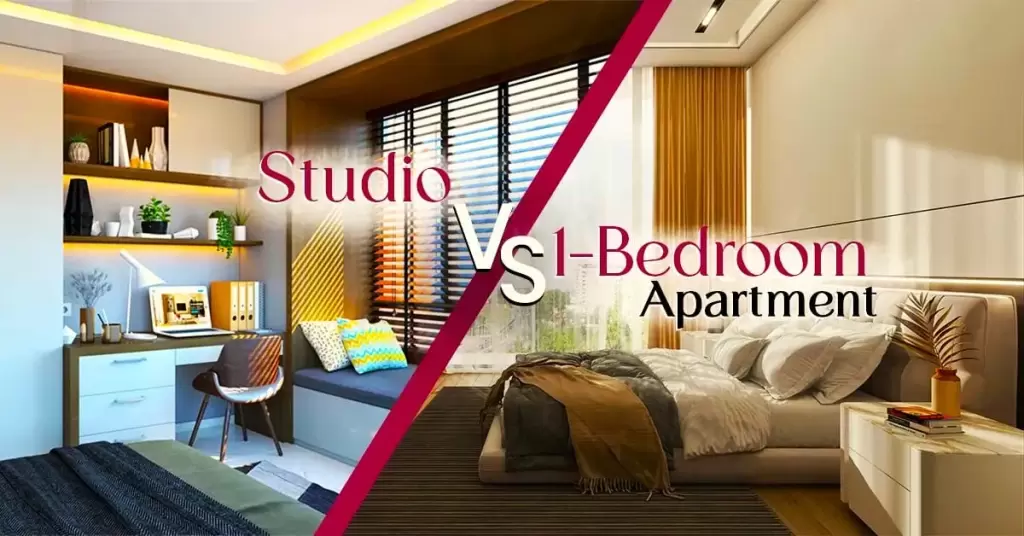
Studios in Dubai deliver gross rental yields of 7.5% to 9% — roughly 0.5 to 1 percentage point higher than 1-bedroom apartments at 7% to 8.5%, based on DLD Rental Index and JLL UAE data for Q1 2026. The gap exists. The question is whether it survives the full cost picture.
Oplus International Realty works through this comparison regularly with investors entering the Dubai market. The gross yield difference is real but narrower net than most comparison articles show.
The Core Difference: Yield Percentage vs Rental Income
A studio and a 1-bedroom apartment serve different investor goals from the start.
A studio delivers a stronger gross yield percentage because its purchase price is lower relative to the rent it commands. A 1-bedroom produces higher absolute rental income in AED, which matters more to investors building long-term cash flow.
Neither is wrong. They are answers to different questions.
Dubai Rental Market, Q1 2026 — What the Data Shows
Dubai recorded AED 32.2 billion in rental contracts in Q1 2026, covering 118,385 new agreements and 135,607 renewals, according to Dubai Land Department data. Cancelled contracts fell 25% compared to Q1 2025. Separately, Savills UAE confirmed 45,208 residential transactions in Q1 2026, with off-plan representing 72% of total deal volume.
Two signals matter for rental investors here. First, new leasing activity is high — tenant demand is absorbing available stock. Second, renewal rates improving and cancellations declining point to a market where tenants are staying longer. That renewal trend benefits 1-bedroom landlords more than studio landlords, given the tenant profile differences discussed below.
Dubai’s citywide residential vacancy rate sits between 4% and 7%, according to JLL UAE Q1 2026 data, meaning landlords in well-positioned communities are finding tenants consistently across both unit types.
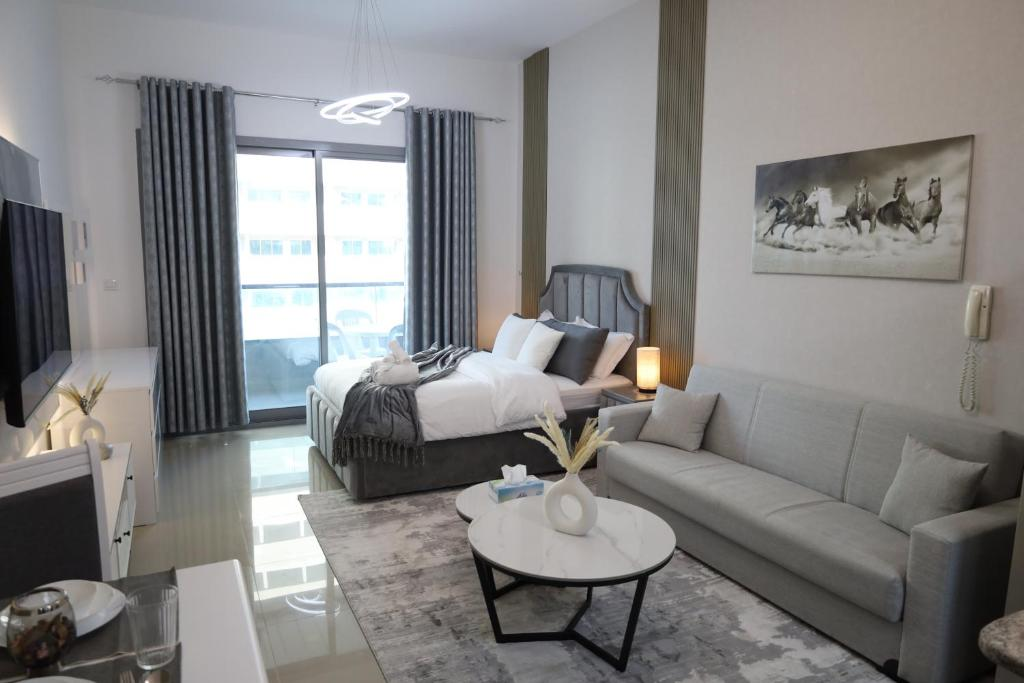
Studio Apartments: The Yield Case
A studio is the lowest-cost entry point into Dubai’s buy-to-let market, and its yield percentage reflects that entry price advantage.
Price and income benchmarks (Q1 2026, DLD transaction data):
- Purchase price range: AED 350,000 – AED 750,000
- Average monthly rent: AED 4,500 – AED 6,500 (AED 54,000 – 78,000 annually)
- Gross yield range: 7.5% – 9% depending on area and building
- Strongest-performing areas by yield: Al Furjan (8.51%), JVC (7.87%), Dubai Silicon Oasis (9.29%)
Example: A studio in JVC purchased at AED 480,000, renting at AED 38,000 per year, produces a gross yield of 7.9%.
Studio tenants are typically single professionals, short-term residents, and young expats. This profile means higher turnover — annual or shorter contracts — but also the ability to reset rent between tenancies at current market rates. In a market where rents are still growing at 4%–6% annually (JLL UAE, Q1 2026), that reset option has real value.
Where studios underperform: Buildings with high service charges reduce the net advantage significantly. A studio in a mid-market JVC tower might pay AED 12,000–18,000 in annual service charges on a 500 sqft unit — that is AED 24–36 per sqft, not AED 12–18, because service charges are charged per sqft but studios have fewer sqft to spread the cost across relative to 1-bedrooms in the same building. The net yield gap between a studio and a 1-bedroom in the same tower can narrow to under 0.5 percentage points after service charges.
1-Bedroom Apartments: The Income Case
A 1-bedroom requires more capital upfront and typically delivers a slightly lower yield percentage. It compensates with higher absolute rent, a wider tenant pool, and lower turnover.
Price and income benchmarks (Q1 2026, DLD transaction data):
- Purchase price range: AED 650,000 – AED 1,400,000 depending on location
- Average monthly rent: AED 6,500 – AED 9,500 (AED 78,000 – 114,000 annually)
- Gross yield range: 7% – 8.5%
- Reference points: Business Bay at 7.6% gross (AED 900K–1.2M purchase, AED 65K–85K annual rent); Dubai Marina at 6.8% gross (AED 1.1M–1.4M, AED 75K–95K annual rent)
Example: A 1-bedroom in Business Bay purchased at AED 1,000,000, renting at AED 75,000 per year, produces a gross yield of 7.5%. Total rental income is AED 37,000 more per year than the JVC studio example above.
The tenant profile shifts here to couples, small families, and professionals on multi-year assignments. These tenants stay longer, generate fewer vacancy gaps, and tend to take better care of the unit — reducing maintenance turnover costs between tenancies.
Side-by-Side Comparison — Q1 2026 Data
| Factor | Studio | 1-Bedroom |
|---|---|---|
| Purchase price (AED) | 350K – 750K | 650K – 1,400K |
| Annual rent (AED) | 54,000 – 78,000 | 78,000 – 114,000 |
| Gross yield range | 7.5% – 9% | 7% – 8.5% |
| Gross yield advantage | +0.5–1pp higher | — |
| Annual rent (AED) advantage | — | +AED 24K–36K higher |
| Service charge | AED 12–18/sqft | AED 12–18/sqft (same rate, more sqft = higher total but lower per-income impact) |
| Tenant turnover | High | Low |
| Vacancy risk | Moderate | Lower |
| Tenant profile | Singles, young professionals | Couples, long-term residents |
| Income stability | Moderate | High |
| Net yield gap vs gross | Narrows after service charges | Widens slightly after service charges |
Source: DLD Rental Index and JLL UAE Q1 2026 market data. Gross yield = annual rent ÷ purchase price × 100.
The Number Most Articles Skip: Net Yield After Service Charges
Gross yield is where most comparisons stop. It should not be.
Service charges in Dubai are levied per square foot annually. The rate is roughly the same for studios and 1-bedrooms in the same building — but the total bill differs because of unit size.
In a mid-market JVC tower with AED 15/sqft service charges:
- A 500 sqft studio pays AED 7,500 annually in service charges
- A 750 sqft 1-bedroom pays AED 11,250 annually
If the studio earns AED 38,000 in annual rent and the 1-bedroom earns AED 55,000, the net rent (before mortgage and management fees) is AED 30,500 vs AED 43,750. The gross yield gap of approximately 0.8 percentage points shrinks to approximately 0.4 percentage points on a net basis — and can disappear entirely in buildings with higher charges or older studios requiring more frequent maintenance.
In Downtown Dubai, service charges run AED 25–35/sqft according to DLD-registered building data. A 500 sqft studio there pays AED 12,500–17,500 in service charges annually — a figure that materially compresses net yield on a unit already priced at a premium.
This is why area selection and building-level due diligence matter more than bedroom count.
Location Shapes the Answer More Than Unit Type
A studio in Al Furjan at 8.51% gross yield outperforms a 1-bedroom in Downtown Dubai at 5%–5.5% gross yield by a significant margin — not because studios are better, but because Al Furjan offers a lower entry price with resilient tenant demand, and Downtown prices a premium that rent alone cannot justify.
The reverse also holds. A 1-bedroom in Business Bay at 7.6% gross yield outperforms a studio in an oversupplied building in the same community where vacancy is running above 10%.
Areas with strongest studio yield Q1 2026 (DLD + JLL UAE data): Dubai Silicon Oasis (9.29%), Al Furjan (8.51%), JVC (7.87%), Jumeirah Lakes Towers (7.22%)
Areas with consistent 1-bedroom demand and yield Q1 2026: Business Bay (7.6%), JVC (7.04%), Dubai Marina (6.8%)
The pattern is consistent: yield is highest where purchase prices are lowest relative to rental demand. That is true for both unit types. Overpaying in a prime location does not produce strong rental returns — it produces capital appreciation exposure with a yield that barely covers costs.
Looking for the perfect property? Contact us now for a free consultation!
Contact us via WhatsAppShort-Term vs Annual Leasing
This choice affects studio returns more than 1-bedroom returns, and it should be part of the calculation before purchase.
Studios in tourist-adjacent or metro-connected zones can generate 20%–50% higher annual income on short-term rental platforms versus annual leases, according to operator data reported to DTCM. The trade-off is management intensity, DTCM permit costs (AED 1,500 per bedroom per year), furnishing expense (AED 20,000–40,000 upfront), and occupancy variability.
Annual leasing for a 1-bedroom produces more predictable income with less active oversight. For investors who prefer a passive income model, this structure fits most holding strategies better than studio short-term rental.
Oplus Perspective
Across inquiries Oplus received in Q1 2026 about Dubai investment units, buyers targeting studios cited yield percentage as their first criterion — almost without exception. Buyers targeting 1-bedrooms consistently cited holding period and exit liquidity as their primary concern.
That split is instructive. It reflects two genuinely different risk profiles. A studio buyer is often optimising for a 2–3 year hold and exit. A 1-bedroom buyer is structuring for 5–7 years with rental income that steadily compounds.
Neither approach is wrong. But an investor who buys a studio with a 5-year mindset, or a 1-bedroom with a 2-year exit plan, tends to end up with a mismatch between asset type and strategy — which is where the real performance gap comes from.
At Oplus, the starting question is always holding period and monthly cash-flow target, not bedroom count.
Costs That Affect Both Unit Types
Before committing, calculate the following for any specific unit — not category averages:
- Annual service charges (obtain from building management, not estimates)
- Vacancy allowance: 4%–7% citywide, but building-specific history matters
- Management fee if using a property manager: 6%–9% of annual rent
- Leasing fee for tenant placement: 5%–10% of annual rent or one month’s rent
- DTCM permit if short-term rental is the strategy
- Maintenance reserve: studios typically require more frequent cosmetic refreshes between tenants
For a more detailed comparison of rental income versus capital growth potential across Dubai communities, the DLD Rental Index guide on the Oplus blog covers the methodology behind area-by-area rent benchmarks.
Who Should Buy a Studio
A studio makes sense if your entry budget is below AED 750,000, your target holding period is under four years, you are comfortable with active tenant management, and your primary metric is gross yield percentage.
The optimal buyer profile: first-time Dubai investor, smaller capital base, yield-maximisation priority, willingness to re-lease annually and reset rents to market.
The risk to account for: 210,000 new residential units are expected to complete across Dubai in 2026–2027, according to Savills UAE pipeline data. In communities with high new supply — Business Bay, JVC, parts of Al Furjan — studio landlords in older buildings may face rent competition from newly completed units. Building quality and location within the community will matter more in 2026 than in previous years.
Who Should Buy a 1-Bedroom
A 1-bedroom makes sense if your entry budget exceeds AED 700,000, your target holding period is five years or more, you want lower vacancy risk, and your primary metric is total AED income per year rather than yield percentage.
The optimal buyer profile: investor building a long-term income portfolio, prioritising stability over maximum headline return, targeting established communities with proven renewal rates.
The honest limitation: a 1-bedroom in a prime location requires more capital to generate proportionally similar yields to a studio in a mid-market community. Investors who stretch their budget to buy in Downtown Dubai or Palm Jumeirah for prestige often find themselves with a 5%–5.5% gross yield that leaves limited margin after costs.
Final Verdict
Studios win on gross yield percentage and entry price. The advantage is real — but smaller net than it appears once service charges, turnover costs, and management fees are applied.
1-bedrooms win on absolute AED income and income stability. The trade-off is more capital required upfront and a slightly lower yield percentage.
The most reliable deciding factor is not bedroom count. It is matching the unit type to the holding period, the community’s supply pipeline, and the specific building’s service charge and vacancy history. Dubai’s Q1 2026 rental data confirms that demand is strong across both categories — the performance gap comes from execution, not the studio-versus-1-bedroom decision itself.
For Dubai investment properties listed on Oplus, the team can provide building-level service charge and vacancy data for specific units before any purchase decision.
Written by: Oplus International Realty Editorial Team
About Oplus: Licensed UAE real estate brokerage based in Abu Dhabi, covering Abu Dhabi and Dubai off-plan, secondary market, and investment properties. RERA registered. oplusrealty.com
Last reviewed: April 22, 2026
Disclaimer: This article is for informational purposes only and does not constitute financial or investment advice. Consult a RERA-licensed professional before any property decision.
Sources: Dubai Land Department — Q1 2026 Rental Market Data Savills UAE — Q1 2026 Residential Transaction Report JLL UAE — Q1 2026 Market Data, Yield and Vacancy Benchmarks DLD Rental Index — Building and Area-Level Rental Benchmarks, Q1 2026 DTCM — Holiday Home Permit Fee Structure 2026
FAQ
What is the average rental yield for a studio apartment in Dubai in 2026?
Studios in Dubai deliver gross rental yields of 7.5% to 9% on average in Q1 2026, based on DLD Rental Index and JLL UAE data. The highest-yielding areas for studios are Dubai Silicon Oasis at 9.29% and Al Furjan at 8.51%. Yields at the lower end of this range typically reflect studios in premium-priced communities where purchase prices are high relative to achievable rents.
Does a studio or a 1-bedroom produce more rental income per year in Dubai?
A 1-bedroom produces more annual rental income in AED — typically AED 78,000 to AED 114,000 per year versus AED 54,000 to AED 78,000 for a studio, based on DLD Rental Index data for Q1 2026. A studio produces a higher yield percentage relative to its purchase price, but lower total income. Which metric matters more depends on whether you are optimising for return rate or absolute cash flow.
Are service charges different for studios vs 1-bedrooms in Dubai?
Service charges are levied at the same rate per square foot for all units in a given building — typically AED 12–18/sqft in JVC and AED 25–35/sqft in Downtown Dubai, according to DLD-registered building data. Because studios are smaller, their total annual service charge bill is lower, but the charge is higher relative to the rent they earn. A 500 sqft studio in JVC at AED 15/sqft pays AED 7,500 annually versus AED 11,250 for a 750 sqft 1-bedroom — but if the studio earns AED 38,000 in rent and the 1-bedroom earns AED 55,000, the service charge consumes a larger share of the studio’s income.
Which areas in Dubai have the best rental yields for studios in 2026?
Based on DLD transaction data and JLL UAE Q1 2026 benchmarks, the top-yielding areas for studios are Dubai Silicon Oasis (9.29%), Al Furjan (8.51%), JVC (7.87%), and Jumeirah Lakes Towers (7.22%). These areas share a common characteristic: relatively low purchase prices combined with strong tenant demand from budget-conscious renters, keeping yields above the Dubai average.
What is the minimum budget to buy a rental studio in Dubai in 2026?
Entry-level studios in Dubai’s buy-to-let market start from approximately AED 350,000 in areas like International City and Dubai Silicon Oasis, based on DLD Q1 2026 transaction data. Studios in mid-market communities like JVC range from AED 480,000 to AED 650,000. Studios in premium locations such as Downtown Dubai and Dubai Marina typically start from AED 750,000 and above, where yield percentages are lower despite the higher entry cost.
How does the 210,000 new unit pipeline affect studio vs 1-bedroom rental income in 2026?
Savills UAE data shows approximately 210,000 residential units are expected to complete across Dubai in 2026–2027. New supply puts downward pressure on rents most acutely in communities where completions are concentrated — Business Bay, JVC, and parts of Al Furjan. Studios in older buildings within high-supply communities face the most direct competition from newly completed units offering modern amenities at similar rents. This risk applies less to well-maintained 1-bedrooms in established submarkets with lower new supply pipelines, such as Dubai Marina and established parts of Downtown.
Is it better to put a Dubai studio on short-term rental or annual lease?
Short-term rental (holiday home) on platforms registered with DTCM can generate 20%–50% more annual income than an annual lease for a well-located studio, according to DTCM operator data. The break-even point depends on occupancy rate, furnishing cost (AED 20,000–40,000 upfront), DTCM permit (AED 1,500 per bedroom per year), and management fees. For investors targeting passive income with minimal active oversight, an annual lease is typically more straightforward. For investors willing to manage occupancy actively or use a professional short-term rental operator, a studio in a tourist-connected zone can outperform the annual lease model meaningfully.
How do I compare a specific studio and 1-bedroom before buying in Dubai?
The most reliable comparison uses four building-specific inputs rather than community averages: the actual annual service charge per sqft (obtained from the building management, not estimates), historical vacancy rate for similar units in that building, the DLD Rental Index benchmark for that specific area and unit type, and the current asking price versus recent comparable transactions. Community-level yield averages can differ by 1–2 percentage points from a specific building’s actual performance depending on age, management quality, and amenity profile. The DLD’s Smart Rental Index provides area-level verified rent benchmarks that are a useful starting point for this assessment.