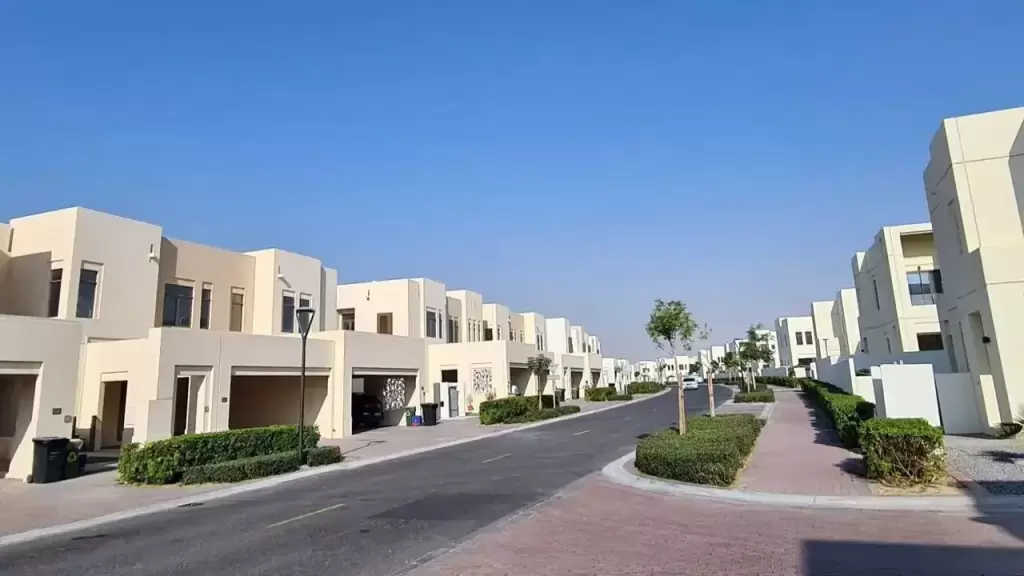
Mira Dubai is an established townhouse community within Reem, developed by Emaar and located along the Al Qudra Road corridor.
Unlike many newer Dubai communities still passing through construction and handover, Mira is primarily a ready secondary-market community. Buyers and tenants can inspect the actual home, street, landscaping and surrounding facilities before making a decision.
That changes how Mira should be evaluated in 2026.
The important questions are no longer whether the community will be completed or what the launch price was.
They are:
What does a Mira townhouse cost today?
What rent can it realistically achieve?
How much does the exact phase, plot and condition affect value?
And does the suburban location fit the household using it?
Current market data shows a community that remains expensive compared with its earlier years but has moved into a much more stable pricing phase.
Mira Dubai at a Glance
| Detail | Current position |
|---|---|
| Community | Mira |
| Master community | Reem |
| Developer | Emaar |
| Main property type | Townhouses / villa-style homes |
| Common layouts | 3 and 4 bedrooms |
| Market status | Predominantly ready / secondary |
| August 2026 sale index | Around AED 1,437/sq.ft |
| August 2026 rental index | Around AED 72/sq.ft |
| Current asking townhouse average | Around AED 3.81M |
| Current asking rent average | Around AED 194K/year |
| Metro inside community | No |
| Main access | Al Qudra Road / Emirates Road |
| Typical buyer | Family end-user or long-hold investor |
Market figures are benchmarks rather than valuations for an individual home.
The exact Mira phase, layout, plot, upgrades and location within the community can create a substantial price difference.
Where Is Mira Dubai?
Mira sits within Emaar’s Reem master community on Dubai’s Al Qudra corridor.
It is a suburban residential location rather than a central urban district.
For residents, that creates a clear trade-off.
Mira offers:
- lower-density residential streets;
- gardens and parks;
- family-sized homes;
- community facilities;
- and space that would generally cost more in more central villa districts.
In return, most households need a car.
There is no Dubai Metro station inside Mira, and commuters working in areas such as Business Bay, DIFC, Dubai Marina or other central districts should test their actual peak-hour journey before moving.
Who Developed Mira?
Mira was developed by Emaar within the wider Reem community.
For buyers researching the company rather than relying on the project name alone, Oplus maintains a current Emaar Properties developer profile covering the developer’s UAE portfolio and current project data.
Emaar Community Management also identifies Mira phases within its historical Reem community portfolio.
In Mira’s case, however, developer reputation is only the first layer of due diligence.
Because the community is established, buyers should now focus heavily on the individual secondary-market property.
Two Emaar-built Mira homes can have very different values after years of different ownership, maintenance and renovation.
What Types of Homes Are in Mira?
Mira is overwhelmingly a townhouse and villa-style community.
Three- and four-bedroom homes dominate the market.
That makes it very different from mixed-use communities where buyers choose between studios, apartments, townhouses and villas.
The benefit is a clear residential profile.
The limitation is reduced housing diversity.
Someone looking for:
- a studio;
- a one-bedroom apartment;
- a high-rise property;
- or an ultra-large luxury mansion
will need to look elsewhere.
Mira 1 to Mira 5: Why the Exact Phase Matters
Searching only for “Mira Dubai” is not enough when buying or renting.
The community is divided into different phases, and current listings show meaningful differences between them.
Property Finder’s current asking-price data, for example, shows average values varying between Mira 2, Mira 3, Mira 4 and Mira 5 rather than one uniform community price.
Differences can come from:
- property type;
- plot;
- proximity to parks;
- corner or end-unit position;
- backing;
- internal upgrades;
- vacancy status;
- and amount of comparable inventory.
The phase matters, but the individual unit often matters even more.
Mira Dubai Property Prices in 2026
Bayut’s August 2026 sale index placed Mira residential pricing at approximately AED 1,437 per sq.ft.
That was approximately 1.4% lower than twelve months earlier.
The same index showed:
- 3-bedroom homes around AED 1,407/sq.ft;
- 4-bedroom homes around AED 1,493/sq.ft.
Three-bedroom pricing was broadly flat annually, while four-bedroom pricing was modestly lower.
This is an important change from describing Mira simply as a rapidly appreciating Dubai community.
In late 2026, the data is closer to price stabilisation.
Current Asking Prices
Portal asking-price data gives another view of what sellers currently want.
Property Finder currently shows an average listed Mira property price of approximately AED 3.68 million, while Bayut’s townhouse inventory averages approximately AED 3.81 million.
Bayut’s current asking averages are approximately:
- 3 bedrooms: AED 3.59M
- 4 bedrooms: AED 4.21M
These are asking prices, not completed transaction values.
That distinction matters.
A buyer should never use a portal average as an automatic valuation of a particular Mira home.
A Real Transaction Example
Current transaction evidence illustrates how much the exact property matters.
A Mira 2 three-bedroom townhouse of approximately 2,616 sq.ft was recorded at:
- AED 3.125M in January 2025;
- AED 3.285M in January 2026;
- AED 3.4M in July 2026;
- AED 3.6M in August 2026.
The same property page shows September 2026 rental transactions of AED 150,000 and AED 172,000 for comparable units.
That is more useful for valuation than saying only that “Mira is a good investment.”
A serious buyer should look for comparable transactions involving the same type and approximate plot, not simply an area-wide average.
Mira 4 Example
The same principle appears in Mira 4.
A current 4-bedroom listing at AED 4.3M shows recent comparable transactions around:
- AED 3.675M in July 2026;
- AED 3.7M in August;
- AED 3.75M in September.
The property itself was rented at AED 176,400 before being marketed for sale.
That gap between completed sales and seller asking price is exactly why buyers should check transaction evidence before making an offer.
How Much Does It Cost to Rent in Mira Dubai?
Mira’s rental market has also become relatively stable.
Bayut’s August 2026 rental index shows approximately AED 72 per sq.ft, about 2% lower year on year.
By bedroom type:
- 3-bedroom: around AED 71/sq.ft;
- 4-bedroom: around AED 72/sq.ft.
Both were modestly below their previous-year levels.
This does not mean every landlord is reducing rent.
It means tenants should no longer assume the market is moving upward at the same rate everywhere.
Current Townhouse Asking Rents
Across current Bayut townhouse inventory, the six-month average asking rent is approximately AED 194,229 per year.
By bedroom count:
- 3 bedrooms: around AED 182,971/year
- 4 bedrooms: around AED 214,318/year
Bayut also reports asking townhouse rents down approximately 3% over the previous six months.
Current individual listings span a wider range.
Recent examples include approximately AED 149K–185K for some three-bedroom homes and around AED 220K for selected four-bedroom properties.
The advertised rent should therefore be compared with the exact property rather than a single community average.
New Lease vs Renewal
Tenants should also distinguish between:
a new property coming to market
and:
an existing tenancy being renewed.
Property Finder currently reports an average of approximately AED 181,837 for new rentals and AED 169,732 for renewed rentals across Mira.
A new tenant should not assume an existing tenant’s renewal rent is the correct benchmark for a vacant upgraded property.
Likewise, a landlord should not assume the highest advertised vacant-property rent automatically applies to a renewal.
Is Mira Good for Rental Investment?
Mira can fit a long-term family-rental strategy because the product is straightforward:
3–4 bedroom homes aimed largely at households that need space.
That is different from an investor buying a studio to maximise gross yield.
The investment case depends on:
- purchase price;
- achievable rent;
- condition;
- maintenance;
- vacancy;
- and eventual resale liquidity.
Bayut currently reports an indicative townhouse ROI of approximately 4.79% based on its market data.
That should be treated only as a market-level reference.
Actual net yield will be lower after ownership costs.
Calculate Net Return, Not Headline ROI
An investor should calculate:
Annual rent − vacancy − maintenance − management − applicable ownership costs
and compare the result with total capital invested.
For an older townhouse, maintenance deserves particular attention.
Potential costs can include:
- air-conditioning;
- waterproofing;
- plumbing;
- landscaping;
- external paint;
- doors and windows;
- appliances;
- and pool maintenance where applicable.
A property producing a slightly higher gross yield can still be the weaker investment if maintenance is consistently expensive.
Condition Matters More as Mira Ages
This is one of the biggest omissions in generic Mira guides.
Mira is no longer a newly handed-over project.
That means two identical original layouts can now be very different homes.
Looking for the perfect property? Contact us now for a free consultation!
Contact us via WhatsAppOne may have:
- upgraded flooring;
- renovated kitchen;
- improved landscaping;
- modern bathrooms;
- better storage;
- and well-maintained AC.
Another may still require significant work.
Buyers should therefore inspect the physical property instead of pricing solely from bedroom count.
Plot and Position Can Change Value
Within the same phase and layout, buyers frequently pay different amounts for:
- single-row positioning;
- park backing;
- corner plots;
- end units;
- larger plots;
- internal quiet roads;
- and upgraded gardens.
These characteristics also matter at resale.
A rare plot can face less direct competition than a standard back-to-back unit.
Is Mira Good for Families?
Family use remains one of Mira’s clearest strengths.
The community provides:
- parks;
- pools;
- playgrounds;
- sports facilities;
- residential streets;
- retail access;
- and family-sized homes.
Dubai British School Mira also operates in the wider local community. Its current admissions documentation lists provision from FS1 through Year 8, with additional year levels planned progressively.
Parents should still check current admissions, fees and year-group availability directly with the school.
Mira Town Centre
Local retail is important because Mira is not a central urban district.
Residents have access to everyday shopping and services within or around the community rather than needing to drive to a large mall for every basic requirement.
However, anyone wanting:
- dense restaurant choice;
- nightlife;
- large-scale shopping;
- or highly walkable urban streets
may prefer a more central location.
Public Transport
Public transport remains one of Mira’s main limitations.
There is no Metro station inside the community.
A household that relies on:
- Metro commuting;
- frequent taxis;
- or walking between employment and home
should consider the transport cost carefully.
Mira generally works much better for car-owning households.
Commute
Travel time should not be judged using an off-peak Google Maps estimate.
Before renting or buying, test the journey during the hours you will actually travel.
This is especially important for people working in:
- DIFC;
- Business Bay;
- Downtown Dubai;
- Dubai Marina;
- or other major employment districts.
A suburban home can provide more space but still become frustrating if the household spends too much time commuting.
Mira vs Arabian Ranches
Mira and Arabian Ranches are often compared because both appeal to family households and sit along the wider suburban Dubai corridor.
Broadly:
Mira
- townhouse-heavy;
- lower entry price in many cases;
- predominantly 3–4BR stock;
- practical family orientation.
Arabian Ranches
- wider villa mix;
- generally larger premium segment;
- longer-established brand and resale market;
- broader range of villa sizes.
The comparison should ultimately be property-to-property.
A heavily upgraded Mira townhouse may compete with stock in another community at a similar budget.
Mira vs Town Square
Town Square provides another relevant comparison.
The major difference is housing diversity.
Town Square contains both apartments and townhouses, while Mira is much more concentrated around family townhouses.
A buyer wanting a lower entry ticket may therefore find more options in Town Square.
A buyer specifically wanting an established Emaar townhouse environment may prefer Mira.
Mira vs DAMAC Hills
DAMAC Hills also offers a wider property range than Mira, including apartments and villas.
Mira is simpler:
family townhouse community first.
This can be an advantage for someone seeking a consistent residential environment, but a disadvantage for households wanting more property choices inside the same neighbourhood.
Buying in Mira: What to Check
Before making an offer, inspect the property in this order.
1. Transaction evidence
Find genuinely comparable recent sales.
Do not use every 3BR in Mira as a comparable.
2. Layout type
Understand the original Emaar type and built-up area.
3. Plot
Check actual land size and position.
4. Renovation
Determine whether upgrades justify the seller’s premium.
5. Structural and maintenance condition
Inspect AC, plumbing, waterproofing, roof and external areas.
6. Occupancy
Is the home vacant, owner-occupied or tenanted?
7. Rental evidence
If buying for income, use current achieved rents rather than optimistic asking rents.
8. Exit market
Understand how many similar units compete with yours.
For wider current Dubai inventory beyond Mira, buyers can compare available homes through the Oplus Dubai property database.
DLD and Transaction Verification
For a secondary-market purchase, transaction and ownership checks are more important than marketing material.
Buyers should confirm:
- title deed;
- seller identity;
- mortgage status;
- property details;
- transaction process;
- and applicable DLD fees.
Oplus’s Dubai Land Department guide covers the registration framework separately.
The Main Pros of Mira Dubai
Established community
The streets, landscaping and homes already exist and can be inspected.
Family-sized properties
Three- and four-bedroom homes dominate.
Emaar development
The community belongs to an established Dubai master-developer ecosystem.
Outdoor environment
Parks and shared outdoor facilities support family use.
Secondary-market evidence
Years of transactions provide buyers with more comparable data than a newly launched project.
The Main Cons
No Metro
Car dependency is significant.
Commute
Central-Dubai workers need to accept a suburban journey.
Limited property diversity
Mira is not suitable for apartment buyers.
Older housing stock
Maintenance and renovation now matter increasingly.
Price differentiation
Similar-looking homes can command very different asking prices, making proper valuation essential.
Who Mira Suits
Mira can make sense for:
- families wanting a 3–4BR home;
- tenants upgrading from an apartment;
- long-term owner-occupiers;
- investors targeting family tenants;
- buyers comfortable with a suburban commute.
It may be less suitable for:
- Metro-dependent residents;
- buyers wanting apartments;
- short-term speculative investors;
- households prioritising nightlife or a dense urban environment.
Frequently Asked Questions
How much does a townhouse cost in Mira Dubai?
Current townhouse asking prices average roughly AED 3.8M, with Bayut reporting around AED 3.59M for 3BR and AED 4.21M for 4BR homes. Individual properties vary significantly by phase, plot and condition.
What is the current price per square foot in Mira?
Bayut’s August 2026 sale index places Mira at approximately AED 1,437 per sq.ft.
How much is rent in Mira?
Current townhouse asking rents average around AED 194K annually. Three-bedroom homes average around AED 183K and four-bedroom homes around AED 214K on Bayut’s current data.
Are Mira property prices still increasing?
Not uniformly. Bayut’s August 2026 index was approximately 1.4% lower year on year overall, with 3BR values broadly flat and 4BR values modestly lower.
Are rents still increasing?
The August rental index was approximately 2% below the previous year, and current townhouse asking rents were also down around 3% over six months.
Who developed Mira Dubai?
Mira forms part of Emaar’s Reem community.
What types of property are available?
The community is dominated by three- and four-bedroom townhouse and villa-style homes.
Does Mira have a Metro station?
No. Most residents rely on private vehicles.
Is Mira a good investment?
It can fit a family-rental or long-hold strategy, but investment performance depends on entry price, achievable rent, condition and resale liquidity. The area should not be treated as a guaranteed-return investment.
Final View
Mira in 2026 is better understood as an established secondary townhouse market than as a new Emaar development.
That distinction changes the buying decision.
The most important factors are now:
Phase → Layout → Plot → Condition → Recent transaction → Rent → Exit
rather than simply:
Mira → Emaar → Buy.
August 2026 data also shows a market that has become more stable: sale values and rents are no longer rising uniformly, giving buyers and tenants more reason to compare individual properties carefully.
For an end-user, Mira’s strongest case remains family-sized housing and an established suburban environment.
For an investor, the strongest case must come from the specific townhouse and its numbers, not from the community name alone.
Published: 26 February 2026
Last reviewed: 24 September 2026
Disclaimer: Property prices, rents and availability change over time. Market indices and portal asking prices do not determine the value of an individual home. Verify recent comparable transactions, title details and the property condition before making a purchase or rental decision.