Dubai’s Roads and Transport Authority reported in November 2025 that the Blue Line metro project is anticipated to boost land and property values by up to 25% around its 14 stations — a figure stated by RTA Director General Mattar Al Tayer at the official construction update, not a broker projection. As of December 2025, construction had reached 12% completion across 12 active sites, with a target of 30% by end of 2026 and a confirmed opening date of September 9, 2029. Oplus International Realty has tracked a measurable shift in Dubai buyer inquiries since the groundbreaking in June 2025, with Blue Line corridor communities now appearing as explicit search filters for a growing share of our Dubai investor briefs.
What the Blue Line Actually Is — and Where It Stands
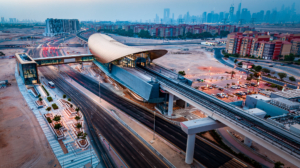
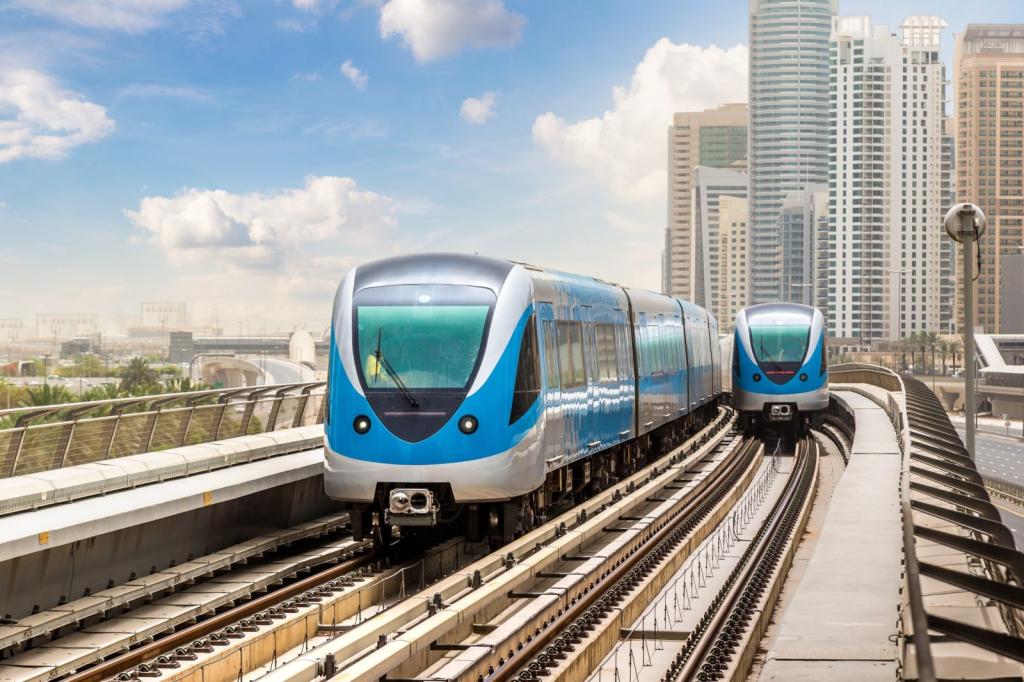
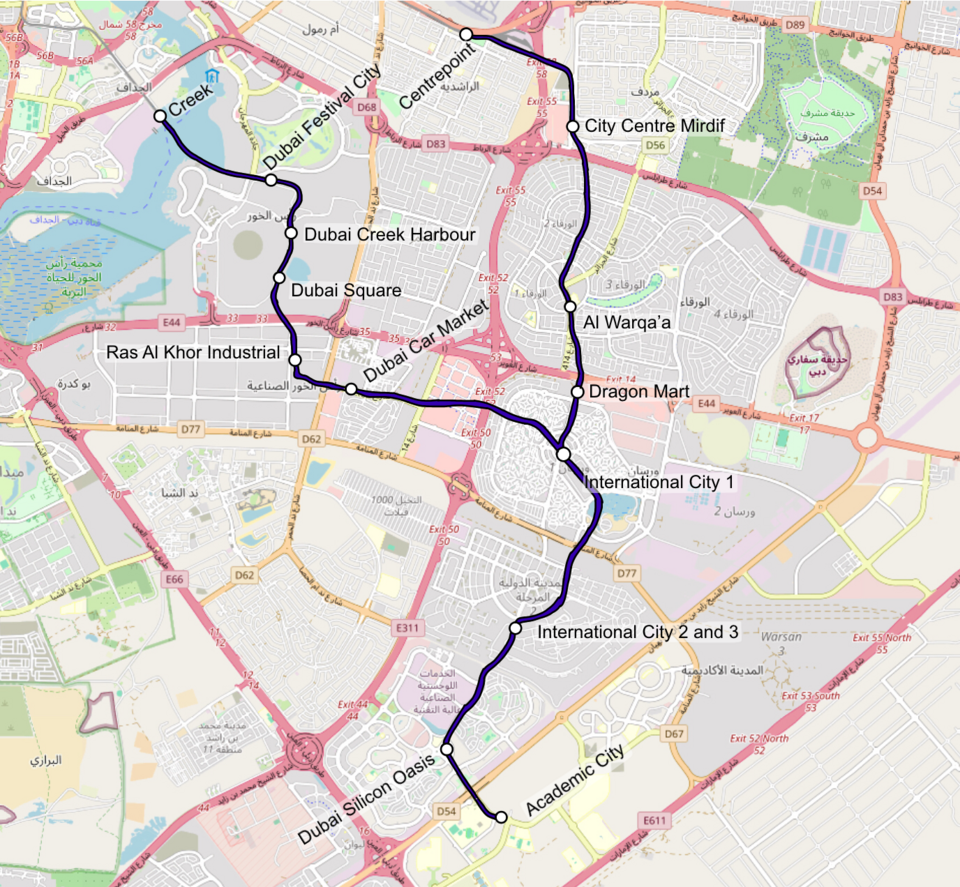
The Dubai Metro Blue Line is a 30-kilometre, 14-station metro line connecting the existing Red Line at Centrepoint station and the Green Line at Creek station in Al Jaddaf. The line is Y-shaped: two branches merge at International City Station 1 before continuing as a single spine to Academic City. Nine stations are elevated; five are underground, including the interchange points.
The project was approved by Sheikh Mohammed bin Rashid Al Maktoum and groundbreaking took place in June 2025. The contract consortium is led by MAPA, Limak, and CRRC Hong Kong. Total project cost is AED 18 billion, according to The National. The RTA confirmed at the December 2025 Blue Line Forum that 4.6 million work hours had been logged and overall completion stood at 12%. The line is the first transport project in Dubai built to platinum-category green building standards, per RTA’s official project description.
Nine key areas are served, per the RTA’s official contract award announcement: Mirdif, Al Warqa, International City 1, 2 and 3, Dubai Silicon Oasis, Academic City, Ras Al Khor Industrial Area, Dubai Creek Harbour, and Dubai Festival City.
For investors, the opening date of September 9, 2029 is the date that matters most. That is when the 25% projected uplift around stations would fully price in. The question is how much of that uplift has already been absorbed into current asking prices.
The 25% Figure: What RTA Said and What It Means
The up to 25% property value increase projection is the RTA’s own estimate, not a third-party forecast. Mattar Al Tayer stated at the official November 2025 construction update that the Blue Line “is anticipated to boost land and property values by up to 25 per cent around Metro stations.” He also stated the project’s total economic benefits are estimated to exceed AED 56.5 billion by 2040.
Two clarifications matter for investors using this number:
First, “up to 25%” is a ceiling, not a floor. Individual districts will see different outcomes depending on their current price level, existing connectivity, supply pipeline, and distance from the actual station. The 25% figure applies to the best-positioned micro-locations.
Second, the projection covers the period from project announcement to stabilisation after opening — not from today forward. Communities that have already repriced substantially since the June 2025 groundbreaking carry a smaller remaining increment. Communities that have absorbed minimal pre-completion uplift carry more.
The honest investor question is not “will prices rise?” — the RTA says they will. The question is: how much has already happened, and how much is still available?
District Analysis: Where the Opportunity Is Uneven
Dubai Creek Harbour is the most visible Blue Line beneficiary. The Emaar Properties station here is being built at 74 metres — described by RTA as the world’s tallest metro station. Dubai Creek Harbour is already an established investment community with DLD-recorded transactions. It benefits from Emaar’s developer backing, waterfront positioning, and the Louvre Abu Dhabi effect on the broader cultural district identity Dubai is building. The Blue Line reduces a meaningful gap in its connectivity — access to Dubai International Airport in 20 minutes direct. For investors who considered Creek Harbour’s distance from central Dubai a risk, the Blue Line is a direct structural answer to that concern. The degree of pre-completion repricing in this community is the variable to watch.
Dubai Silicon Oasis has already experienced a significant price run. The Blue Line announcement follows gains reported by Gulf News of approximately 80% in apartment prices between end 2022 and 2024, and roughly 50% per square foot in the 12 months prior to the Blue Line groundbreaking. Investors who entered early have captured most of the pre-announcement uplift. Those entering now are paying a different price base and should model their returns accordingly. The Blue Line still matters here — DSO was transport-constrained, and metro access removes a real occupancy barrier for tech-sector tenants who do not own cars. But the entry price relative to achievable yield is now materially different from 18 months ago.
International City (1, 2, and 3) holds the most concentrated Blue Line infrastructure: International City Station 1 is the Y-junction where both branches merge, giving it an interchange status comparable to Centrepoint and Creek. The underground station at International City 1 means construction impact is significant now, but the eventual connectivity is among the best on the line. Rental demand in this community is driven by affordability-motivated tenants rather than lifestyle preference, which means metro access directly addresses a genuine gap in occupational convenience. Entry prices remain among the lowest on the Blue Line route.
Mirdif and Al Warqa are family-oriented communities with stable occupancy and long-term tenant profiles. Metro access has historically increased demand from end-users and long-term residents rather than short-term speculative activity, which produces a different but more durable return profile. These areas are not distressed or undervalued — they are established. The Blue Line adds a commute improvement for existing residents and makes the area accessible to a wider pool of potential tenants who currently drive to work from further west.
Dubai Festival City and Ras Al Khor complete the route. Festival City is already a mature mixed-use district adjacent to IKEA and multiple retail anchors. The Blue Line accelerates an ongoing evolution rather than creating a new one. Ras Al Khor serves an industrial corridor and benefits connectivity-wise primarily for workers rather than residential investors.
The Risk Section Competitors Tend to Omit
Infrastructure projects in Dubai have slipped before. The Blue Line opening of September 9, 2029 is the RTA’s confirmed target — it is not a guarantee. The project is currently on schedule per the December 2025 update, but 13 months into a 48-month construction programme, “on schedule” is a reasonable condition, not an ironclad commitment. Investors modelling specific return timelines that depend on a September 2029 handover should stress-test against a 12 to 18-month delay.
The pre-completion repricing risk is real. Infrastructure investment theses in Dubai are now widely discussed — including in this article. When an opportunity is widely understood, early-mover advantage compresses. Communities that have already repriced by 30% to 50% since 2022 (Silicon Oasis) are a different investment from communities where the uplift has not yet been absorbed (parts of International City, Al Warqa).
Concentration risk applies to investors who build a Dubai portfolio exclusively around one infrastructure theme. Metro access matters, but it competes with other value drivers: developer quality, supply pipeline, school access, master plan execution, and global economic conditions affecting Dubai’s tenant population.
There is also the question of which yield survives from purchase price to stabilised rent. An investor who buys in International City at a 20% premium to 2023 prices on the strength of Blue Line expectations still needs the rent to follow. That depends on whether the tenant profile in those communities actually changes — or whether the same affordability-led tenants simply benefit from a shorter commute without paying a premium for it.
One Development Competitors Have Largely Missed
On April 22, 2026, Dubai officially announced the Gold Line metro — 42 kilometres, 18 stations, all underground, connecting Al Ghubaiba on the Green Line through Business Bay and Jumeirah Golf Estates, with connections to Etihad Rail at Meydan and Jumeirah Golf Estates. The Gold Line target opening is September 9, 2032.
This matters for Blue Line investors in two ways. First, it confirms that Dubai’s infrastructure commitment to transit-oriented development is not a one-cycle event — it is a multi-decade capital programme. Second, it opens a new set of communities to the same pre-completion investment thesis. The disciplines that apply to the Blue Line analysis — timing relative to announced uplifts, distance from actual stations, supply pipeline — apply equally to the Gold Line.
Investors who understand the Blue Line opportunity structurally, not just by area name, are better positioned to identify the next comparable situation in Dubai’s infrastructure cycle.
Who This Investment Thesis Suits
Based on the inquiry patterns Oplus sees from Dubai investors in 2026, the Blue Line thesis is most coherently pursued by three profiles. The first is the long-horizon yield buyer who wants a tenant-accessible community at a lower entry price than prime Dubai, is comfortable holding through the 2029 opening and into a stabilised rental period, and is not dependent on pre-handover resale to generate returns.
The second is the end-user who is buying a primary or secondary residence near their workplace or commute corridor and for whom the Blue Line reduces a genuine practical friction. For this buyer, the investment case is secondary to the lifestyle case — and that combination is more durable over time.
The third is the off-plan buyer entering pre-launch in the months before a Blue Line community becomes widely marketed on infrastructure grounds. That window is narrowing for the communities featured in this analysis.
The Blue Line thesis is less suited to investors who need returns within 24 to 36 months, investors whose capital requirements depend on accurate knowledge of the 2029 opening date, and investors who have not modelled the current entry price against achievable rents in the specific community they are considering.
For a detailed comparison of Dubai investment areas with verified DLD pricing data, the Dubai investment guides on Oplus provide district-level analysis updated quarterly. For current Dubai Creek Harbour listings with DLD-verified pricing context, the Oplus Dubai Creek Harbour property page covers both off-plan and secondary market availability.
Frequently Asked Questions
When does the Dubai Metro Blue Line open?
The confirmed opening date is September 9, 2029 — the 20th anniversary of the Dubai Metro — as stated by RTA Director General Mattar Al Tayer. The project is a 30-kilometre, 14-station line connecting the Red and Green Lines. As of December 2025, construction had reached 12% overall completion, with a target of 30% by end of 2026. The RTA confirmed the project is on schedule at the December 2025 Blue Line Forum. All infrastructure schedules carry timeline risk; investors should plan for a 12 to 18-month delay scenario alongside the on-time case.
What areas does the Dubai Metro Blue Line serve?
The Blue Line’s nine key service areas, confirmed by the RTA at the official contract award, are: Mirdif, Al Warqa, International City 1 and 2 (and 3 on one branch), Dubai Silicon Oasis, Academic City, Ras Al Khor Industrial Area, Dubai Creek Harbour, and Dubai Festival City. The line connects to the Green Line at Creek station in Al Jaddaf and to the Red Line at Centrepoint station in Al Rashidiya, giving it dual interchange access.
How much will the Blue Line increase property values?
The RTA Director General stated in November 2025 that the Blue Line is anticipated to boost land and property values by up to 25% around Metro stations. This is the RTA’s own projection, not a third-party estimate. The 25% represents the upper range — individual outcomes will vary by district, entry price, distance from the actual station, and how much pre-completion repricing has already occurred in each community. Some Blue Line communities (Dubai Silicon Oasis) have already experienced substantial price appreciation since 2022.
Is Dubai Creek Harbour a good investment ahead of the Blue Line?
Dubai Creek Harbour sits at the end of one Blue Line branch and will have the world’s tallest metro station at 74 metres, per RTA. DLD-recorded transaction data shows the community has logged thousands of sales with occupancy rates in ready buildings above 88% per available market analysis. The Blue Line addresses a genuine connectivity gap — the direct airport journey of 20 minutes is a meaningful upgrade. The investment case depends on the entry price relative to achievable rent: buying at current secondary market prices requires a different yield calculation than buying at 2020–2021 off-plan prices.
What is the risk of investing near Blue Line stations before completion?
Three risks are specific to pre-completion infrastructure investing in Dubai. Timeline risk: the September 2029 date is confirmed but not guaranteed; a delay shifts the repricing curve. Pre-completion pricing risk: communities widely discussed as Blue Line beneficiaries may already have absorbed much of the pre-opening uplift into current asking prices. Supply pipeline risk: if a community attracts high developer activity because of the Blue Line announcement, new supply could cap rental growth even after metro access improves. Stress-test each investment against a 12-month delay and against a scenario where new supply adds 15% to 20% to available inventory.
What is the Dubai Gold Line and does it affect the Blue Line investment thesis?
Dubai officially announced the Gold Line on April 22, 2026 — 42 kilometres, 18 stations, all underground, connecting Al Ghubaiba through Business Bay, Mohammed Bin Rashid City, Meydan, and Jumeirah Golf Estates, with Etihad Rail connections at two points. The target opening is September 9, 2032. The Gold Line confirmation extends Dubai’s infrastructure investment thesis beyond the Blue Line and opens a parallel pre-completion opportunity in a different set of communities. It confirms that the Blue Line is not a one-off event but part of a multi-line, multi-decade transit programme.
Which Blue Line communities still have the most pre-completion upside?
This depends on what is already priced in. Communities where price appreciation since 2022 has been relatively contained — parts of International City, Al Warqa, and certain Mirdif sub-areas — may carry more remaining pre-opening upside than communities like Dubai Silicon Oasis that have already experienced 80% gains over the same period. The RTA’s up-to-25% projection covers the full project timeline from announcement to stabilisation. Investors entering in 2026 need to calculate how much of that range has already been consumed at their target community’s current price point.
Written by: Oplus International Realty Editorial Team
About Oplus: Licensed UAE real estate brokerage based in Abu Dhabi, covering Abu Dhabi and Dubai off-plan, secondary market, and investment properties. RERA registered. oplusrealty.com
Last reviewed: May 2026
Disclaimer: This article is for informational purposes only and does not constitute financial or investment advice. Consult a RERA-licensed professional before any property decision. Infrastructure timelines are subject to change.
Sources Roads and Transport Authority (RTA) — Blue Line official construction update, Government of Dubai Media Office (mediaoffice.ae), November 9, 2025: 10% completion, AED 56.5B economic benefit projection, up to 25% property value uplift around stations RTA / Government of Dubai — Blue Line Forum December 2025: 12% completion, 4.6 million work hours RTA — Blue Line contract award announcement: nine key areas, 14 stations, September 9 2029 opening, AED 18 billion project cost (The National, June 2025) Khaleej Times — Blue Line route map: 9 elevated, 5 underground stations; 14.5 km above ground, 15.5 km underground Dubai official announcement — Gold Line: 42 km, 18 stations, target September 9, 2032 (April 22, 2026) Gulf News — Dubai Metro expansion property price analysis, June 2025