
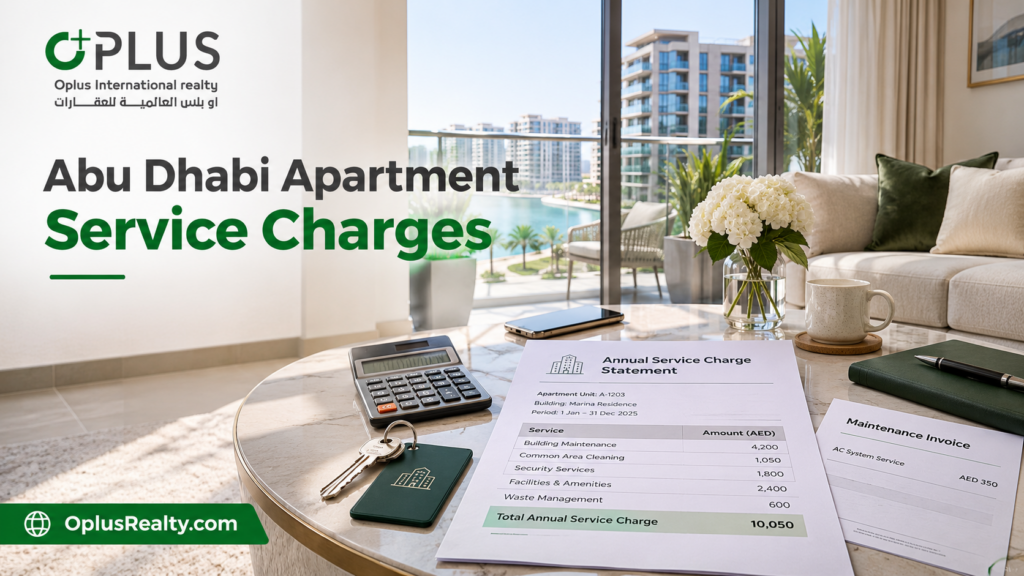
Apartment service charges in Abu Dhabi are a recurring ownership cost that can reduce rental income and affect a property’s resale process if unpaid. Buyers should verify the approved building budget, the unit’s actual annual charges and any outstanding balance before signing. Oplus International Realty explains the Abu Dhabi Real Estate Centre’s framework and how to measure the cost against net rental returns.
What Are Apartment Service Charges in Abu Dhabi?
Service charges are payments collected from owners of units in jointly owned properties to fund the operation, maintenance, management and repair of shared parts and facilities.
The Abu Dhabi Real Estate Centre (ADREC) oversees community-management regulation and service-charge approvals within the framework of Abu Dhabi’s applicable property legislation.
For a residential apartment building, the approved budget may cover several shared expenses.
| Cost category | What it can include |
|---|---|
| Building operations | Security, cleaning, management and shared-area services |
| Common mechanical systems | Lift maintenance and shared building equipment |
| Common utilities | Shared electricity, water and applicable cooling infrastructure |
| Shared amenities | Pools, gyms, landscaping and communal facilities where included |
| Property insurance | Insurance covering the building and common parts |
| Reserve provisions | Funds for emergencies and future replacement of shared equipment |
| Master-community services | Shared infrastructure and facilities across the wider development, where applicable |
The exact allocation depends on the approved property and community budget.
A buyer should not assume that every building includes the same facilities or that all cooling and utility expenses are covered.
Personal utility bills, repairs inside the apartment, landlord-specific insurance and property-management fees may be separate costs.
The aim is to identify the complete recurring ownership expense without double-counting items already included in the approved service-charge budget.
Who Approves Abu Dhabi Service Charges?
Under Abu Dhabi’s revised real estate framework, management companies are responsible for preparing the applicable service-charge budgets and collecting approved amounts from owners.
The regulatory basis includes Law No. 3 of 2015, as amended by Law No. 2 of 2025, and Administrative Decision No. 25 of 2025 concerning jointly owned properties, common parts and facilities.
Article 29 of the administrative decision links each owner’s share to the unit’s area relative to the relevant common property under the mechanism adopted by ADREC.
The decision also requires the relevant approval before qualifying service charges can be imposed.
What does budget approval mean?
An approved budget establishes the basis for collecting the relevant charges.
It does not, on its own, prove that a particular owner has settled all invoices.
For a resale purchase, investors need two types of evidence:
- The approved budget and the calculation applicable to the unit.
- The unit’s actual account statement showing invoices, payments, adjustments and any outstanding balance.
These records answer different questions and should not be treated as interchangeable.
ADREC’s Community Affairs guidance confirms that management companies submit budgets for approval and issue invoices based on approved amounts.
How to Check Service Charges Before Buying an Abu Dhabi Apartment
The safest approach is to check the exact building and unit rather than rely on a neighbourhood-wide estimate.
Step 1: Identify the unit and responsible management company
Obtain the property’s registered details, apartment number, project name and relevant management company.
The building name shown in an advertisement may differ from the name used on invoices or community-management records.
Confirm the applicable ownership and registration route, particularly if the property is on Al Reem Island or Al Maryah Island.
Step 2: Request the approved budget
Ask the seller or authorised management company for the latest approved service-charge budget and the unit’s share or applicable rate.
Verify the financial year and the expense categories included.
If the management company provides an AED-per-square-foot rate, confirm which registered or chargeable area is used and whether the figure represents all applicable approved components.
Do not multiply an advertised apartment area by an assumed rate without checking the method used in the actual invoice.
Step 3: Obtain the unit’s invoices
Request the latest service-charge invoices, together with previous periods where available.
Check the amount charged, billing period, due dates, payments received and any adjustments or credits.
A previous year’s charge may help with historical comparison, but it does not establish the next approved rate.
Step 4: Verify outstanding balances
Request a current statement of account and the applicable service-charge clearance documentation.
ADREC’s Community Affairs guidance states that outstanding service charges must be settled before completing a sale or transfer.
The buyer, seller and relevant management company should resolve any discrepancy before completion.
An annual budget approval is not proof that a unit has no arrears.
Step 5: Compare the amount with the rental-income model
Once the applicable annual charge has been confirmed, include it in the investment’s operating expenses.
Use the actual approved amount and the same accounting period as the annual rent.
This produces a more useful comparison than applying a general service-charge average to every apartment in Al Reem, Yas Island, Saadiyat Island or another Abu Dhabi area.
Calculating the Annual Service Charge
The property’s approved allocation determines the actual charge.
Where a valid approved rate is expressed per square foot of chargeable area, the calculation is straightforward:
Annual service charge = Approved rate per square foot × Chargeable area
For example, a hypothetical apartment with a chargeable area of 900 sq ft and a modelled rate of AED 12 per sq ft would have an annual service charge of AED 10,800.
That is the equivalent of AED 900 per month as a budgeting average.
It does not mean the building actually invoices monthly or that AED 12 is the approved rate for any named apartment building.
Use the correct area
The area in the sale advertisement is not necessarily the figure used to allocate building costs.
Compare the registered property record, approved budget and invoice before calculating the amount.
If the management company uses an allocation schedule rather than a single visible AED-per-square-foot rate, use the approved unit-specific charge instead of reconstructing a different formula.
Check for master-community components
A development may have expenses associated with the building itself and shared facilities serving the wider community.
These components must be identified in the approved budget and applicable invoice.
If a published total already includes a master-community allocation, adding that allocation again would overstate the owner’s cost.
The same principle applies to shared cooling, insurance and reserve provisions.
What Is Changing in Abu Dhabi Service Charges for 2027?
ADREC announced an updated approach to service-charge budgeting, approvals and invoicing that applies to budgets from 2027 onward.
The new approach separates annual charges into three categories:
| Category | What the buyer should understand |
|---|---|
| Community Service Charges | The relevant community-level service-charge component |
| Master Community Fees | Applicable wider-development or master-community costs |
| Surplus / Deficit | Financial adjustments based on audited community accounts |
ADREC also announced up to four budget approvals annually, between two and four invoices for owners, and quarterly financial statements.
This announcement concerns the updated budgeting framework for 2027 and later periods. It should not be described as an accounting format already used for every 2026 property invoice.
Why investors should pay attention
A clearer breakdown helps investors distinguish recurring service costs from adjustments arising from previous budget performance.
A surplus may reflect a different position from a deficit requiring future funding.
Investors should review the relevant statements before assuming that a historical charge will continue unchanged.
When comparing a 2026 invoice with a 2027 budget, make sure changes in how items are presented do not create a misleading apparent increase or decrease.
A reclassification of costs is not automatically an increase in the underlying cost of running the building.
Who Pays Service Charges When an Apartment Is Rented?
The owner remains responsible for the service charges associated with the property.
ADREC’s published Community Affairs guidance makes this explicit, including where the unit is leased to a tenant.
An owner should therefore budget for service charges when calculating rental income.
If a lease includes a contractual arrangement for recovering certain expenses from the tenant, the landlord still needs to establish the enforceable terms and the responsibility owed to the management company.
Do not assume that an occupied property eliminates the owner’s exposure to service charges.
A tenant’s rent payment and the owner’s approved service-charge liability are different obligations.
How Service Charges Change Net Rental Yield
A property’s gross rental yield does not show how much income the owner retains.
Service charges can make a meaningful difference even when two apartments have the same purchase price and gross rent.
A hypothetical apartment investment
Assume a completed residential apartment has the following characteristics:
| Item | Modelled value |
|---|---|
| Purchase price | AED 1,300,000 |
| Acquisition costs | AED 50,000 |
| Annual rent before vacancy allowance | AED 84,000 |
| Chargeable area | 900 sq ft |
| Private maintenance allowance | AED 4,000 |
| Property-management allowance | AED 3,000 |
| Vacancy allowance | AED 4,000 |
| Landlord-specific insurance allowance | AED 1,000 |
The annual expenses other than service charges total AED 12,000.
All inputs are hypothetical. They do not represent a specific Oplus listing, rental contract or official Abu Dhabi service-charge quotation.
Comparing two service-charge scenarios
| Financial measure | Scenario A | Scenario B |
|---|---|---|
| Hypothetical service-charge rate | AED 12/sq ft | AED 20/sq ft |
| Annual service charge | AED 10,800 | AED 18,000 |
| Annual gross rental income | AED 84,000 | AED 84,000 |
| Other operating costs and allowances | AED 12,000 | AED 12,000 |
| Annual net rental cash | AED 61,200 | AED 54,000 |
| Gross rental yield | 6.46% | 6.46% |
| Net rental yield on acquisition capital | 4.53% | 4.00% |
The net yield is calculated against AED 1,350,000 of modelled capital, comprising the property price and acquisition costs.
Scenario B reduces annual net income by AED 7,200 and net yield by approximately 0.53 percentage points.
The exercise shows why a gross rental-yield advertisement cannot establish which apartment provides the better return.
Does lower service charge mean a better building?
Not necessarily.
A lower charge may reflect different facilities, building systems, maintenance requirements or budget arrangements.
A building with lower annual charges may also have future maintenance needs that are not obvious from its latest invoice.
A buyer should compare the full building condition, services provided, reserve position, rental evidence and sale price.
The lowest charge per square foot is not automatically the lowest long-term ownership risk.
Stress-Test a Possible Service-Charge Increase
The approved charge can change between budget periods.
Using Scenario A above, suppose the annual service charge increases by a hypothetical 25%, while rent and other costs remain unchanged.
The charge would rise from AED 10,800 to AED 13,500.
Annual net rental cash would fall from AED 61,200 to AED 58,500, and modelled net yield would decline from 4.53% to 4.33%.
This is a sensitivity test, not an ADREC forecast or a prediction for a particular building.
The purpose is to establish whether the investment remains viable if shared-property costs increase.
A similar test can be conducted for weaker rent, longer vacancy, additional maintenance or a combination of adverse conditions.
Service Charges, Reserve Funds and Major Repairs
The latest invoice shows a current expense, but it may not explain the building’s future maintenance requirements.
ADREC’s 2025 administrative framework addresses reserve provisions for emergency expenditure and replacement of equipment in common parts.
The annual budget must include the relevant contribution to the reserve account.
ADREC also highlighted reserve-fund shortfalls in its June 2026 Community Affairs updates, drawing attention to asset-replacement planning and the need to identify funding gaps.
What should a buyer request?
Where available, ask for the approved budget, recent financial statements, reserve-fund information and relevant maintenance plans.
Review whether the building has major mechanical equipment or shared facilities approaching a scheduled replacement cycle.
Ask whether the management company has reported a deficit or proposed a budget adjustment.
These checks do not guarantee future costs, but they can reveal issues that are not visible in the current year’s service-charge rate.
Do not assume an approved low annual fee proves the building has sufficient funds for every future repair.
Unpaid Service Charges and Property Transfers
Outstanding service charges should be investigated before a buyer signs a binding purchase agreement.
The revised Abu Dhabi framework provides security and collection mechanisms relating to unpaid service charges.
Article 30 of Administrative Decision No. 25 of 2025 addresses the management company’s collection rights and recognises a lien over the unit and its associated rights.
The provision also addresses the effect of ownership transfer.
ADREC’s Community Affairs guidance separately confirms the need to clear outstanding service charges before a sale or transfer.
What should the buyer obtain?
| Evidence | Purpose |
|---|---|
| Latest approved budget | Verify the basis of the annual fee |
| Current invoice | Confirm the actual charge for the unit |
| Statement of account | Identify unpaid invoices, credits and adjustments |
| Clearance confirmation | Establish what must be settled before transfer |
| Relevant correspondence | Identify disputes or pending adjustments |
| Written completion settlement | Document the handling of amounts attributable to each party’s ownership period |
The purchase agreement should address the settlement of existing arrears and relevant charges covering the completion date.
Do not assume that a private agreement between buyer and seller resolves an existing claim recorded against the unit without the relevant clearance process.
What if the amount is disputed?
The buyer should obtain the invoice and supporting details rather than rely on an informal assurance.
The owner may first raise the matter with the community management company, then use the owners’ committee and appropriate ADREC channels where applicable.
Dispute rights, collection procedures and deadlines must be checked against the current law and the precise notice served.
A disputed invoice should not simply be ignored while a transfer is being arranged.
Are Service Charges Payable Before Off-Plan Handover?
A newly completed property raises a different issue from a ready resale apartment.
Administrative Decision No. 25 of 2025 addresses the developer’s responsibility for expenses, including service and community charges, incurred before handover.
Article 29 includes an exception where the developer establishes that the buyer refused or delayed possession for qualifying reasons beyond the developer’s control.
The treatment of a particular handover invoice therefore depends on the actual events, contractual record and applicable provisions.
It is unsafe to claim that service charges always begin on the advertised handover date or that a buyer never owes charges until receiving the keys.
Ask for the completion and handover documents, approved budget, billed period and explanation of the date from which the charge is being requested.
If possession or billing is disputed, specialist advice may be required before withholding payment or signing a handover acknowledgement.
Al Reem and Al Maryah Islands: Check the Registration Route
Buyers should not assume every apartment transaction in Abu Dhabi uses the same title-registration system.
Abu Dhabi Global Market’s AccessRP platform provides real-property services for Al Reem Island and Al Maryah Island, including ownership transfers, title certificates and lease registrations.
This distinction matters when arranging a purchase or verifying ownership documents.
However, a title-registration service is not automatically the source of every building’s approved service-charge budget.
For an apartment on either island, identify the applicable registration authority, community-management entity, approved budget and any relevant regulatory requirements.
Obtain the unit’s actual invoices and clearance information rather than treating Dubai’s DLD Service Charge Index as an Abu Dhabi fee calculator.
For the wider buying considerations on the island, see Al Reem Island Apartments in 2026.
Compare Communities Without Inventing Average Rates
An investor researching Abu Dhabi may shortlist Al Reem Island, Masdar City, Yas Island, Saadiyat Island, Al Raha Beach or other residential areas.
Service-charge comparisons should be made at the property and building level.
A community-level estimate can conceal differences between towers, shared facilities, financial years and chargeable areas.
| Research factor | What to compare |
|---|---|
| Building identity | Exact tower and development rather than area name alone |
| Budget year | Charges approved for the same accounting period |
| Area definition | Registered or approved chargeable area |
| Shared facilities | What maintenance and operation the fee covers |
| Community costs | Any separate approved wider-development components |
| Reserve position | Available funding and expected major replacements |
| Historical invoices | Actual changes rather than assumed future rates |
| Property income | Comparable rent and vacancy costs |
Avoid claiming that Abu Dhabi apartments have a fixed percentage service-charge advantage over Dubai apartments.
A meaningful cross-emirate comparison requires comparable properties, accounting years, expense categories and actual approved data.
For broader budget planning, see Investing AED 1 Million in Abu Dhabi Property.
What to Check Before Making an Offer
Before committing to an Abu Dhabi apartment purchase, investors should establish the applicable ownership-registration route and the exact management entity.
They should also have the approved budget, the current service-charge statement, a clear record of arrears and the actual rental information needed for a net-yield calculation.
If the charge appears unusually low or high, investigate the scope of services and reserve provision rather than assuming it represents good or bad management.
For off-plan property, distinguish estimated future charges from approved charges for a completed building.
Finally, run a conservative financial scenario that includes a possible increase in building costs.
Final Assessment
Abu Dhabi apartment service charges affect annual ownership costs, net rental income and potentially the completion of a resale transaction.
A buyer should not accept a generic rate quoted for an entire neighbourhood.
Use the property’s approved charge, the correct area or allocation, the latest invoices and a current statement of account.
Then calculate the impact on net income alongside maintenance, management, insurance and vacancy costs.
Oplus International Realty can help buyers identify the documents and financial assumptions relevant to an Abu Dhabi apartment investment. Contact Oplus to discuss your property requirements.
Sources
- Abu Dhabi Real Estate Centre — Community Affairs, including service-charge budgeting, owner responsibilities, arrears guidance and 2026–2027 regulatory updates.
- Abu Dhabi Real Estate Centre — Rules and Regulations, Law No. 3 of 2015 as amended by Law No. 2 of 2025, and Administrative Decision No. 25 of 2025, particularly Articles 29, 30, 34–36.
- Abu Dhabi Global Market — AccessRP Real Property Services, property registration for Al Reem and Al Maryah islands.
By Oplus International Realty Editorial Team
The numerical examples are hypothetical and do not represent approved service-charge rates for named buildings. Transaction-specific obligations and disputes depend on the property’s actual records and applicable legal framework.