Abu Dhabi’s rental supply pipeline grew by 9,000 units on 17 April 2026, when the Department of Municipalities and Transport (DMT) and Aldar formalised a development partnership for two communities in Baniyas and Mohamed Bin Zayed City. According to the Abu Dhabi Media Office, the projects carry a combined gross development value of AED 2.8 billion and target delivery by 2029.
What the DMT–Aldar Agreement Covers
Under the partnership, Aldar leads the development, leasing, and long-term management of both communities. DMT grants long-term leasing rights over the government-owned land but does not transfer ownership. No land sale takes place. This structure keeps the units permanently off the for-sale market and preserves them as professionally managed rental stock under a government-influenced pricing framework.
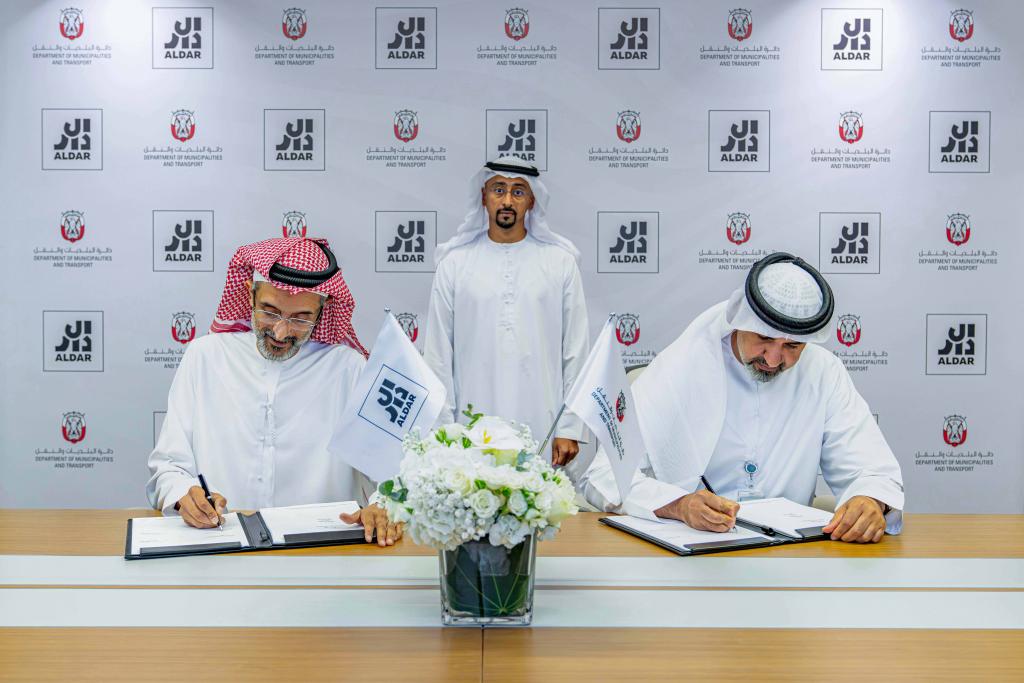
The agreement was signed by Ahmed Fadhel Almehairbi, Director General of Abu Dhabi City Municipality, and Jassem Saleh Busaibe, Chief Executive Officer of Aldar Investment, in the presence of Nasser Saleh Farah, Director General of Financial Affairs at DMT, per the Abu Dhabi Media Office.
The AED 2.8 billion in gross development value from this partnership brings Aldar’s total develop-to-hold pipeline to AED 20.1 billion, according to the same official announcement.
The Two Projects — Baniyas and MBZ City
The Baniyas development sits along the Abu Dhabi–Al Ain highway (E22). Over 30 residential buildings will form the community, which combines residential units with retail outlets, recreational amenities, and landscaped green areas. The E22 corridor connects Abu Dhabi city centre directly to Al Ain, passing industrial and logistics employment zones along the way — a location profile that suits working households reliant on road commutes.
The MBZ City project takes a different approach. The Abu Dhabi Media Office specifies it will combine single-occupancy accommodation with multi-tenant apartments — a unit mix that targets solo residents and smaller households, not only families. Both communities include on-site retail and support services designed for daily use.
No unit breakdown between the two sites has been disclosed. The 9,000-unit figure covers both communities combined.
How These 9,000 Units Fit Abu Dhabi’s 2025–2026 Pipeline
The scale of this supply addition becomes clearer against the broader development context. DMT approved nearly 75 million square metres of gross floor area across Abu Dhabi in 2025, a 137% year-on-year increase, according to the Abu Dhabi Media Office in March 2026. Housing accounted for the largest share — approximately 190,000 residential units across new and existing neighbourhoods, of which roughly 30,000 are designated for UAE Nationals and 158,000-plus are market-rate units.
The 9,000 units from this partnership represent approximately 4.7% of that market-rate residential pipeline. That proportion matters. The announcement is a targeted supply injection into the mid-market rental segment — not a response at the scale of the overall gap. It addresses a specific tenant profile in specific locations, rather than reshaping the Abu Dhabi rental market as a whole.
WAM reported that 12,309 buildings were completed across Abu Dhabi in the first half of 2025 alone. Construction output across the emirate is accelerating, and this partnership sits within a broader wave of approved development that will take several years to fully reach market.
The Value Housing Programme — From MoU to Active Delivery
DMT launched the Value Housing Programme in March 2025 through two preliminary agreements — one with Sdeira Group (formerly KEZAD Communities) and one with Central Holding Group, per DMT’s official website at dmt.gov.ae. The programme aims to deliver affordable, quality housing in well-connected communities across multiple income segments, from studios through to larger apartments.
The Aldar partnership is the first firm, AED-denominated contract to emerge from that programme. The shift from memoranda of understanding to a formal AED 2.8 billion development agreement marks the Value Housing Programme moving from its announcement phase into active delivery — thirteen months after its public launch.
DMT reduced its master developer approval cycle by 60 days during 2025, according to the Abu Dhabi Media Office, which shortens the gap between formal agreements like this one and ground-breaking.
Aldar’s Develop-to-Hold Model and What It Means for Renters
Aldar builds, manages, and retains develop-to-hold assets as long-term rental income rather than selling them at handover. Jassem Busaibe, CEO of Aldar Investment, has described this as a core growth driver for the company in Aldar’s public statements. The AED 20.1 billion pipeline figure — now inclusive of the Baniyas and MBZ City communities — reflects Aldar’s position as the emirate’s primary government-aligned residential landlord at scale.
Looking for the perfect property? Contact us now for a free consultation!
Contact us via WhatsAppFor renters, the model carries a practical implication: units in professionally managed Aldar communities follow consistent standards for maintenance, facilities, and tenancy administration. That contrasts with the informal or fragmented private rental stock that typically fills the mid-market gap the Value Housing Programme is targeting.
How Aldar and DMT structure rental pricing and eligibility — whether units are open to anyone who applies or reserved for specific income bands — has not been announced.
Who These Units Are Designed to House
Abu Dhabi rents rose approximately 20% in 2024, according to reporting by The National based on market data. Pressure has concentrated most acutely in the mid-market segment, where demand from working professionals, single occupants, and families on mid-range incomes has outrun formal supply.
The Baniyas development’s location on the E22 corridor serves residents who commute to employment in Abu Dhabi’s logistics, industrial, and urban core areas. Its community layout — retail, recreation, green space — points toward family households.
The MBZ City project is more specific in its targeting. The explicit inclusion of single-occupancy units addresses a segment that has historically been underserved in Abu Dhabi’s formal rental market, with many solo workers relying on illegally partitioned apartments. DMT and Aldar have framed the broader programme as serving residents across multiple income levels, with quality as a minimum standard across all segments.
Risks and Gaps the Announcement Does Not Address
Three gaps stand out.
No rental pricing or eligibility criteria have been disclosed. Without those details, it is not possible to assess whether the units will be accessible to the income groups the programme claims to target, or whether market forces will push rents toward rates that only mid-to-upper earners can sustain.
The 2029 delivery date is three years away. Abu Dhabi’s rental market will continue to evolve independently in that period. If private supply — including the broader 190,000-unit pipeline — reaches market faster than demand growth, the value context for these units may look different at handover than it does in April 2026.
The government land lease structure aligns Aldar’s incentives with long-term asset retention rather than short-term sales revenue. That is a structural advantage for supply stability. The downside is that the terms DMT sets on pricing and eligibility are not public, and renters have no visibility into what the lease agreement requires Aldar to deliver.
Frequently Asked Questions
Are the 9,000 units available to all nationalities or only UAE nationals?
The Value Housing Programme is directed at all Abu Dhabi residents, not exclusively UAE nationals. DMT’s official website describes the programme as serving individuals and families across multiple income segments. The MBZ City development specifically includes single-occupancy accommodation and multi-tenant apartments — unit types used by expatriate workers and solo residents. Specific eligibility criteria for the Aldar-managed communities have not been published as of April 2026.
Will these units ever be available to buy?
No. Under the develop-to-hold structure, Aldar retains ownership of both communities as long-term rental assets. DMT grants Aldar leasing rights over government-owned land, but neither the land nor the residential units will be offered for sale at any stage. These developments are built entirely for the rental market. Buyers seeking ownership in Abu Dhabi should refer to Aldar’s separate for-sale residential portfolio on Yas Island, Saadiyat, and other designated freehold areas.
What is MBZ City and why was it selected for one of the two communities?
Mohamed Bin Zayed City (MBZ City) is an established residential district in Abu Dhabi with a mix of apartment and villa communities, good arterial road access, and existing community infrastructure. DMT selected it for the Value Housing Programme given the mid-market demand concentration in that area and the district’s capacity to support a mixed unit type — single-occupancy and multi-tenant — serving the range of household profiles common across MBZ City’s current population.
How will the E22 location of Baniyas affect daily commutes?
The Abu Dhabi–Al Ain highway (E22) links Abu Dhabi city centre directly to Al Ain, passing industrial zones and logistics employment areas along the route. Baniyas residents will have direct road access to central Abu Dhabi and to employment areas in the emirate’s eastern corridor. The official announcement references direct connections to Abu Dhabi’s public transport and major road networks, but specific bus routes or metro links for this development have not been confirmed. Verify current transport options via the Integrated Transport Centre.
How can renters register interest in the Baniyas or MBZ City developments?
No application process or leasing platform has been announced as of April 2026. Both communities target completion in 2029; a formal leasing process is expected through DMT’s official channels at dmt.gov.ae and Aldar’s rental management platform closer to that date. Monitor those sources directly. Aldar’s existing rental portfolio is managed through Aldar Investment — contacting that division when the programme opens will be the most direct route.