

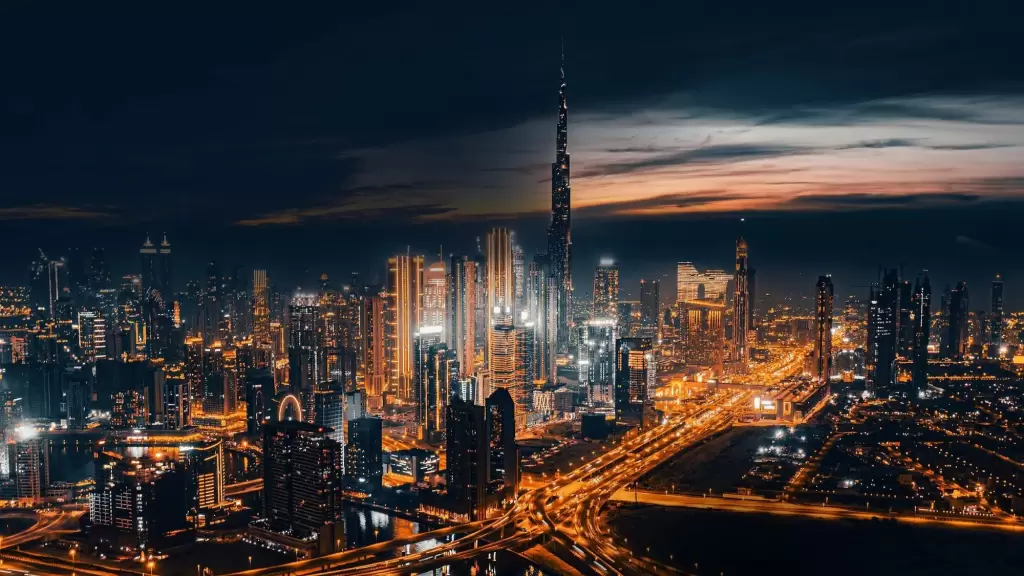
The UAE property market in 2026 is entering a new phase—one defined less by speculative launches and more by infrastructure, employment ecosystems, and long-term capital allocation. While the market remains structurally strong, the forces driving demand are evolving in ways that will significantly influence where people live, where businesses locate, and which areas outperform.
Rather than broad-based price inflation, value is becoming increasingly corridor-specific. Energy investment, transport connectivity, and digital infrastructure are now acting together to create clusters of demand—resetting how investors, developers, and end-users assess opportunity across the Emirates.
UAE property demand in 2026 is becoming infrastructure-led
More than AED 143 billion in construction contracts awarded in early 2025 signalled a clear transition in how growth is being deployed across the UAE. Instead of isolated real estate cycles, capital is now flowing into energy systems, transport networks, and digital capacity—and property demand is increasingly following these investments.
This shift means that:
- Not all locations will rise together
- Value will concentrate where jobs, mobility, and housing intersect
- Long-term resilience will matter more than launch-driven hype
For investors, 2026 is less about chasing momentum and more about following national strategy.
Energy investment is quietly reshaping residential demand
Clean and alternative energy projects are emerging as an under-appreciated driver of property demand. Under the UAE Energy Strategy 2050, clean energy is targeted to reach around 50% of the national energy mix, supported by projected investments of up to AED 600 billion over the coming decades.
This capital is not just building power capacity—it is creating:
- New employment zones
- Logistics and operational hubs
- Demand for nearby housing and mixed-use developments
In Dubai, the Clean Energy Strategy targeting 75% renewable electricity by 2050 is reinforcing demand in specific corridors rather than inflating prices citywide. Over time, areas adjacent to renewable parks, hydrogen projects, and transmission infrastructure are evolving into self-sustaining residential-commercial ecosystems.
Transport connectivity is redefining land value
Transport remains one of the most consistent predictors of long-term property performance in the UAE. In 2026, connectivity is no longer a premium feature—it is a baseline requirement.
Major projects such as:
- Dubai Metro Blue Line
- Strategic road expansions
- National freight and logistics corridors
are tightening land availability around nodes and stations. Areas once considered peripheral are being re-priced as viable residential and business locations, especially when commute times shrink and accessibility improves.
This trend is visible in renewed interest around Dubai Creek Harbour, Festival City, parts of Dubai Silicon Oasis, and logistics-linked districts tied to future rail and metro access.
Technology and AI are changing commercial property fundamentals
The UAE’s ambition to position itself as a global technology and AI hub is creating a new layer of real estate demand—particularly for:
- Data centres
- Innovation districts
- Technology-linked industrial and office assets
Unlike traditional office stock, these assets tend to attract longer leases, higher-quality tenants, and more stable cash flows. As a result, the composition of commercial demand is shifting away from short-cycle speculation toward infrastructure-backed occupancy.
For mixed-use developments, this is critical. Areas that combine residential living with innovation and employment hubs are seeing stronger long-term absorption than single-use projects.
Mixed-use communities become the default model
By 2026, the UAE’s long-standing urban planning vision—shorter commutes, integrated living, and sustainable density—is reaching an inflection point.
New developments are increasingly designed as fully integrated communities, combining:
- Residential units
- Offices and co-working
- Retail and lifestyle amenities
- Public transport access
This marks a decisive shift away from isolated or purely gated residential projects toward connected, future-ready urban ecosystems. For residents, it improves work-life balance. For investors, it supports longer tenancy, stronger retention, and pricing resilience.
Looking for the perfect property? Contact us now for a free consultation!
Contact us via WhatsAppWhy Dubai’s cost advantage still supports development
Despite rising global construction costs, Dubai remains one of the most cost-efficient build markets in the region. Scale, predictable regulation, and integrated supply chains continue to support competitive delivery—especially in mid-market residential and logistics segments.
While sustainability and smart-building requirements are increasing upfront costs at the premium end, the trade-off is:
- Higher tenant demand
- Better efficiency metrics
- Stronger long-term asset resilience
In 2026, cost efficiency alone will not win—but cost efficiency combined with future-proof design will.
Digital construction reduces risk, not just cost
Technology is also reshaping how projects are delivered. Tools such as:
- Building Information Modelling (BIM)
- AI-assisted planning
- Real-time site monitoring
are shifting procurement decisions away from the lowest price toward execution certainty. For investors, fewer delays and lower rework risk translate into more predictable returns.
In the UAE, digital capability is no longer a differentiator—it is becoming a baseline requirement for credible large-scale development.
Non-oil growth underpins long-term demand
With the non-oil economy now accounting for more than 75% of UAE GDP, property demand is increasingly supported by:
- Financial services
- Tourism and hospitality
- Trade and regional headquarters
Professionals and entrepreneurs attracted by these sectors tend to favour long-term housing within integrated communities, reinforcing demand for mixed-use assets that combine living, working, and lifestyle in one location.
Infrastructure is creating new value corridors
Projects such as the Dubai Metro Blue Line and Etihad Rail are already reshaping investor behaviour—well ahead of completion.
Rather than chasing completed infrastructure, buyers are now pricing in future accessibility, leading to earlier demand in districts connected to:
- Metro stations
- Rail logistics nodes
- Inter-emirate transport corridors
This is creating entirely new residential and commercial clusters that did not exist in previous cycles.
What to watch in the UAE property market in 2026
As higher oil output strengthens public finances and smart-city investment accelerates, 2026 is shaping up to be a year of discipline rather than exuberance.
Key themes to monitor:
- Quality over quantity
- Infrastructure alignment
- Sustainability and tech readiness
- Employment-driven demand, not speculation
Assets that are well-connected, technologically enabled, and sustainability-ready are likely to outperform, while older or poorly positioned stock may face increasing pressure to adapt.
Conclusion: Follow infrastructure, not hype
The next phase of the UAE property market will reward those who follow energy investment, transport connectivity, and employment growth—not momentum alone.
In 2026, success will be defined by alignment: between policy, infrastructure, jobs, and liveability. Prime, future-ready assets are positioned to outperform, while speculative supply will be tested in a more selective market.
At OPlus Realty, we guide clients through these shifts by focusing on fundamentals—not noise.
📊 Request a strategic consultation to identify UAE property opportunities aligned with 2026 growth corridors.