

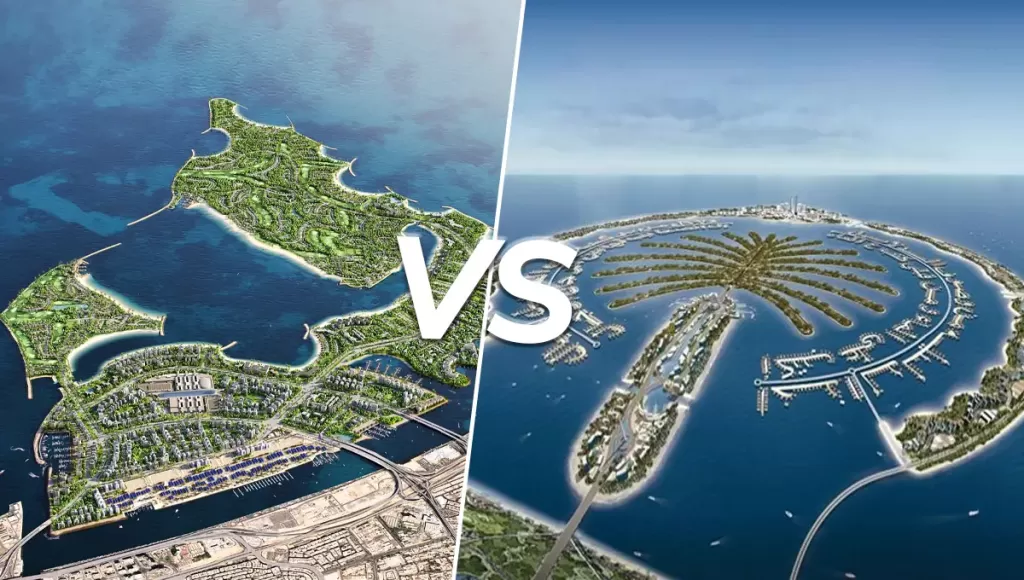
Dubai Islands vs Palm Jumeirah comes down to one practical question: do you want an established, fully operational luxury island today—or are you buying into a newer destination designed to mature over the next cycle? Palm Jumeirah is already a globally recognised lifestyle hub with deep resale history and an operational hospitality ecosystem. Dubai Islands is a five-island waterfront destination planned to evolve in phases, with value tied to delivery sequencing, destination branding, and long-term district build-out.
For buyers and investors in 2025, that difference matters because it affects timeline, liquidity, and risk. In an established market, your underwriting is clearer: you can inspect buildings, benchmark service charges, and compare like-for-like transactions. In an emerging market, your upside can be meaningful—but your results depend more on handover timing, surrounding infrastructure, and how quickly lifestyle demand scales.
If you’re choosing between Dubai Islands vs Palm Jumeirah, this guide helps you decide with a simple framework—then move straight into viewing shortlists.
Dubai Islands vs Palm Jumeirah in 60 seconds
Palm Jumeirah = established “ready-now” island living. It’s master developed by Nakheel, extends into the Arabian Gulf, and is home to a large residential and leisure ecosystem.
Dubai Islands = emerging “next chapter” waterfront destination. Nakheel positions it as a future-facing project aligned with Dubai’s long-term urban vision and delivered as five interconnected islands.
Translation:
- If you want certainty + immediate use + easier resale comparisons, Palm Jumeirah usually wins.
- If you want earlier entry + growth runway + larger destination evolution, Dubai Islands can be the better fit.
Masterplan scale, maturity, and “destination risk”
Palm Jumeirah is a mature destination: buyers are not waiting for the “big picture” to arrive. The ecosystem—residential, hospitality, marinas, and retail—already functions daily. That lowers what investors call destination risk: your outcomes rely less on future phases and more on unit quality, view line, building reputation, and pricing discipline.
Dubai Islands is the opposite profile. Nakheel describes it as a waterfront destination across five isles, with beaches, resorts, and cultural hubs forming a broader long-term concept.
That means the investment story often depends on:
- What phase you buy
- When your building hands over
- Which district elements are operating at that time
- How quickly the destination builds repeat visitor and resident demand
In practical terms, Palm’s value is often defensive (stability + brand recognition). Dubai Islands’ value is often offensive (growth potential as the destination matures).
Location and connectivity: Deira coast vs Dubai’s prime shoreline
Palm Jumeirah sits on Dubai’s most established coastline corridor, benefiting from proximity to major leisure districts and premium residential zones. That matters for:
- second-home owners who want fast access to “Dubai’s greatest hits”
- landlords who rely on proven short-stay and long-stay demand
- buyers who prioritise prestige and global recognition
Dubai Islands is positioned off the Deira coastline—closer to older Dubai’s commercial heritage and northern transport corridors—while still targeting modern beachfront living. Nakheel frames it as a new waterfront destination aligned with the city’s future livability goals.
The real takeaway: Palm is central-to-prime lifestyle today. Dubai Islands is central-to-north Dubai evolution over time. Your best choice depends on where you spend your week—not just what looks good on a brochure.
- Dubai Creek vs Dubai Marina
- Palm Jebel Ali vs Palm Jumeirah
- Emirates Hills vs Palm Jumeirah
- Jumeirah Park vs Jumeirah Islands
Property options today: ready homes vs phase-led launches
Palm Jumeirah offers breadth and immediacy. You can buy:
- apartments and penthouses in established towers
- branded residences and hotel-linked formats
- signature villas and frond villas (depending on segment)
Because it’s mature, you can do real due diligence: compare layouts, understand building management, and assess noise, traffic, and public access patterns.
Dubai Islands is building depth over time. Today, buyers often see early-stage or off-plan-led inventory with lifestyle districts expanding as new phases complete. Nakheel’s positioning focuses on a next-generation waterfront experience spanning multiple islands.
If you want move-in usability, Palm typically delivers faster. If you want earlier-cycle entry, Dubai Islands tends to provide that—at the cost of more variables.
Rental demand, resale liquidity, and what investors actually measure
Most investors don’t lose money because they pick the “wrong island.” They lose money because they underwrite the wrong things.
Here’s what matters in Dubai Islands vs Palm Jumeirah underwriting:
Looking for the perfect property? Contact us now for a free consultation!
Contact us via WhatsApp- Resale liquidity (exit options)
Palm’s maturity usually makes benchmarking easier. Comparable sales exist, and global demand is well-established. - Rental depth (tenant demand stability)
Prime, established destinations tend to attract multiple demand pools: lifestyle renters, corporate tenants, and seasonal visitors. - Supply risk (market-wide)
Dubai is still delivering significant new supply across 2025–2026. Fitch has warned that higher deliveries could pressure prices, even if prime areas remain more resilient than oversupplied segments.
This is why “where you buy” and “what you buy” matters more than headlines. - Unit-level performance drivers
On both islands, view line, beach access, building reputation, and layout efficiency often explain performance better than the community name alone.
If you want a stability profile in a market where supply is expanding, Palm typically feels more straightforward. If you want a growth profile, Dubai Islands can work—but you need a longer horizon and stronger project selection discipline.
Ownership costs: service charges, maintenance, and coastal wear
Ownership costs are where many “great deals” quietly break.
Palm Jumeirah ownership realities
Because it’s coastal and heavily lifestyle-oriented, the key cost drivers tend to be:
- service charges (building amenities, beachfront upkeep, security, common areas)
- premium facility maintenance (pools, gyms, concierge-style services in some towers)
- coastal wear on exposed elements in certain formats (especially if sea-facing)
Palm is master developed by Nakheel and hosts a dense ecosystem of leisure and residential assets, which supports the lifestyle—but also creates ongoing operational complexity.
Dubai Islands ownership realities
Because it’s developing in phases, the key cost drivers often depend on the specific project and timeline:
- early years may have “new build” advantages in maintenance cycles
- service charge structures may evolve as districts and public realm mature
- your lived experience depends on what surrounding districts are delivered and operating
Dubai Islands is positioned as a future waterfront destination across five isles—so long-term operational maturity matters.
Who should buy what in 2025?
Use this section as your decision engine.
Best fit profiles (quick and practical)
- Stability-focused investor: Palm Jumeirah is usually the safer “known quantity” due to maturity and brand recognition.
- Growth-focused investor: Dubai Islands can fit if you accept delivery sequencing and a longer horizon tied to destination build-out.
- End user (primary home): Choose based on weekly life—privacy, traffic patterns, and whether you want an established lifestyle hub (Palm) or a newer, evolving waterfront setting (Dubai Islands).
- Second-home buyer: Palm tends to work better for “arrive tomorrow and live fully,” while Dubai Islands can work well if you plan ahead for handover and ecosystem maturity.
Decision checklist (pick what you can live with):
- Palm friction: higher entry pricing + more public-facing destination patterns
- Dubai Islands friction: patience + phased delivery + evolving destination feel
FAQ: Dubai Islands vs Palm Jumeirah
Yes—because they represent two different investment stages. Palm Jumeirah is established with a mature ecosystem, while Dubai Islands is still evolving in phases. Your choice depends on whether you value immediate usability and clearer benchmarks, or longer-term upside linked to destination growth.
Nakheel is the master developer behind Palm Jumeirah and the Dubai Islands destination concept. This matters for planning continuity, long-term community delivery, and how the waterfront lifestyle ecosystem is designed and operated across each project.
Palm Jumeirah is typically stronger for immediate income strategies because it has established demand patterns, operating amenities, and mature lifestyle infrastructure. Dubai Islands can work, but rental depth tends to strengthen as handovers complete and the destination matures over time.
Dubai Islands is often evaluated as a longer-horizon play because value can rise as districts deliver and the destination brand strengthens. Palm Jumeirah can still appreciate, but it behaves more like a mature market where gains are often more selective and unit-specific.
Some analysts warn that higher deliveries across 2025–2026 could pressure prices, even if prime areas may prove more resilient than oversupplied segments. This is why buyers should focus on unit quality, building reputation, and realistic exit plans—not just community branding.
Palm Jumeirah is widely sold as a freehold-style investment market for international buyers, but eligibility depends on the specific transaction structure and current regulations. Always confirm title type, fees, and the purchase process with a licensed broker and official documentation before committing.
No. Dubai Islands is still in its development cycle, with the destination evolving in phases. That means handover dates, district readiness, and the surrounding lifestyle ecosystem can differ significantly by project—so phase selection is critical.
Conclusion
Dubai Islands vs Palm Jumeirah isn’t about choosing the “better island.” It’s about choosing the right investment profile for your timeline. Palm Jumeirah is the established, globally recognised option: it offers immediate usability, mature lifestyle infrastructure, and clearer benchmarking for resale and leasing. Dubai Islands is the emerging destination story: a five-island waterfront plan designed to evolve in phases, where patient buyers may benefit as districts mature and the coastal ecosystem fills in.
In 2025–2026, market-wide supply dynamics matter, so discipline matters more than hype. Don’t buy a headline—buy a unit with a clear use case, realistic exit options, and ownership costs you’ve modelled properly.
Ready to choose? We can shortlist options side-by-side, compare service charges and layouts, and arrange viewings.