
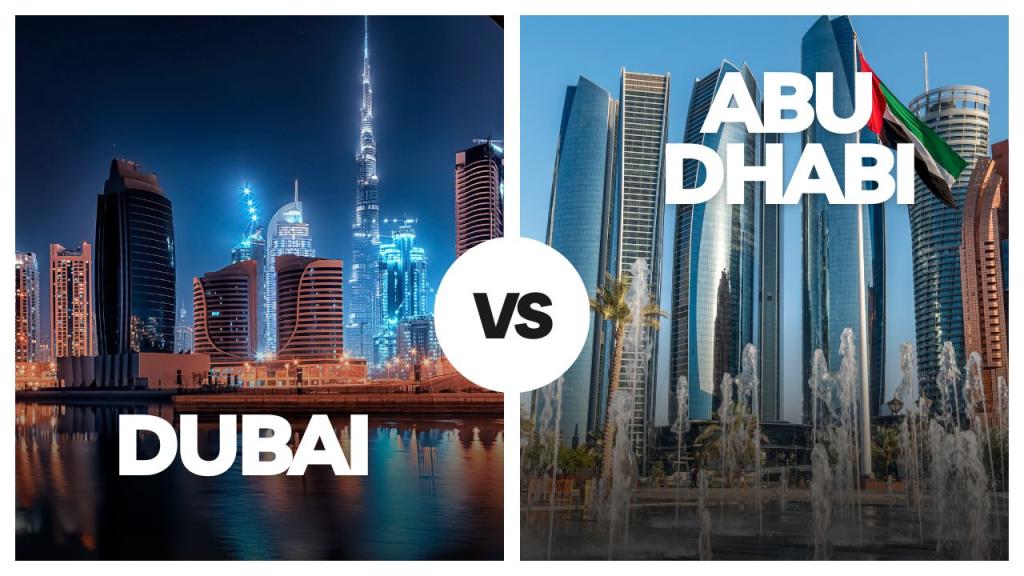
Abu Dhabi’s apartment prices grew 22.7% year-on-year in Q1 2026, against Dubai’s 12.5% over the same period — figures drawn respectively from ValuStrat’s Q1 2026 Real Estate Review published May 10, 2026, and the Dubai Land Department’s official Q1 2026 report. For most of the past decade, Dubai was the assumed winner on capital appreciation. That assumption now requires a closer look. Oplus International Realty operates across both markets and this analysis uses Q1 2026 official data from ADREC and DLD to compare the two investment cases directly.
The Market Size Gap — and Why It Still Matters
The scale difference between the two markets shapes everything from liquidity to exit options.
| Metric | Dubai | Abu Dhabi | Source |
|---|---|---|---|
| Q1 2026 total transactions | AED 252B / 60,303 deals | AED 66B / 13,518 deals | DLD + ADREC official, April 2026 |
| Full year 2025 total | AED 919B / 275,442 deals | AED 142B / 42,814 deals | DLD + ADREC official |
| Q1 2026 YoY value growth | +31% | +160.7% | DLD + ADREC official |
| FDI Q1 2026 | Not separately reported | AED 8.27B / 99 nationalities / +423% YoY | ADREC official |
| Off-plan share Q1 2026 | 70% of volume | 80% of volume | DLD + ValuStrat |
Dubai’s market is roughly four times Abu Dhabi’s by transaction value in Q1 2026. That gap matters for secondary market liquidity: more buyers and more sellers means faster exit options when you need them. Abu Dhabi’s 160.7% growth rate against Dubai’s 31% reflects a smaller base accelerating rapidly — not a market that has already overtaken Dubai in absolute depth.
The FDI figure for Abu Dhabi deserves specific attention. AED 8.27 billion in foreign investment from 99 nationalities in a single quarter — equivalent to all of 2025’s FDI in three months — signals that international capital is entering Abu Dhabi’s market at a pace that has not been seen before. Whether that pace sustains through Q2 and Q3 2026 is the key variable to watch.
Price Per Square Foot — Where Each Market Stands
The headline prices for both markets in Q1 2026, from official sources:
Dubai: Average AED 1,759 per square foot across all residential transactions, up 12.5% year-on-year per DLD official data. Premium communities range from AED 1,448/sqft in JVC to AED 6,428/sqft for Palm Jumeirah villas. The January 2026 monthly record of AED 72.4 billion confirms that peak pricing in Dubai is still moving upward.
Abu Dhabi: Ready units averaged AED 1,146 per square foot per ValuStrat Q1 2026. Off-plan units averaged AED 2,191 per square foot — a 38% premium over ready stock, and a 21.6% quarter-on-quarter increase that reflects the intensity of demand for new launches. Saadiyat Island commands AED 1,800–2,800/sqft for apartments; Al Reem Island sits at AED 900–1,400/sqft.
The practical implication: for the same budget, Abu Dhabi’s ready market delivers more floor area than Dubai’s equivalent. A AED 2 million budget buys approximately 1,750 sqft of ready apartment in Abu Dhabi against approximately 1,137 sqft at Dubai’s average. That difference matters for end-user buyers and for tenant satisfaction in the rental market.
Capital Appreciation — The Inversion Most Guides Have Not Caught
This is the comparison that most existing analysis gets wrong in 2026, because much of it was written on 2024 or early 2025 data.
ValuStrat’s Q1 2026 Price Index for Abu Dhabi reached 148 points — a 17.8% annual increase and a 6.4% quarterly rise. Within that, apartments recorded 22.7% year-on-year appreciation and 10.4% quarter-on-quarter growth. Villas added 13.4% year-on-year and 2.7% quarterly.
Dubai’s DLD Q1 2026 data shows 12.5% year-on-year growth in average price per sqft — strong by any global standard, but now below Abu Dhabi’s apartment performance on the same metric.
ValuStrat’s Head of Real Estate Research Haider Tuaima offered the most precise explanation in the May 10, 2026 report: Abu Dhabi is at a comparatively later position in the property cycle relative to Dubai, with more accessible price points continuing to support end-user demand. In other words — Abu Dhabi is earlier in its appreciation run. Dubai experienced its sharpest acceleration between 2021 and 2024. Abu Dhabi’s acceleration is happening now.
This does not mean Abu Dhabi will definitively outperform Dubai over the next five years. It means the narrative that Dubai always wins on capital growth requires updating with current data before any investor decision is made.
Rental Yields — Closer Than Reported
Both markets produce competitive rental income. The difference is narrower than most comparison articles suggest.
Dubai gross rental yields average approximately 6.76% across all residential property per Engel & Völkers April 2026 data, with apartments in high-demand areas — JVC, Business Bay, Dubai South — frequently exceeding 7%. The Dubai ROI guide published by Oplus covers the gross-to-net gap in detail: after service charges of AED 12–35/sqft and management costs, realistic net yields for annual leases run 5–7% depending on community and building.
Abu Dhabi yields range 6–8% across investment zones per market data cross-referenced with ADREC’s rental index. The repeat lease price index recorded a 16% annual increase as of March 2026, confirming rental demand growth. ValuStrat Q1 2026 noted Abu Dhabi’s residential rental occupancy at 88.1% — a mature, balanced rental market rather than a tight supply crisis. Net yields after Abu Dhabi’s service charges of AED 25–45/sqft (approximately 15–20% lower than Dubai’s equivalent per Middle East Insider March 2026 analysis) run approximately 5.7–6.6% for Al Reem Island apartments, with higher-performing areas like Al Reef exceeding 8% gross.
The yield differential between the two markets is real but modest for most asset types. The more meaningful difference is service charge structure: Abu Dhabi’s lower annual maintenance costs improve net yield calculations in a way that headline gross yield comparisons obscure.
Transaction Costs — The AED 40,000 Difference
The fee differential between the two markets is concrete, calculable, and frequently underestimated.
| Fee | Dubai | Abu Dhabi |
|---|---|---|
| Transfer/registration fee | 4% of purchase price (DLD) | 2% of purchase price (DMT — Executive Council Resolution No. 49 of 2018) |
| Agency commission | 2% + VAT | 2% (buyer or seller, by agreement) |
| Trustee/transfer office | ~AED 4,000 | ~AED 1,000–2,000 |
| Mortgage registration (if applicable) | 0.25% of loan + AED 290 | ~AED 400 fixed |
| Total transaction cost (typical range) | 7–8% of purchase price | 5–7% of purchase price |
On a AED 2,000,000 purchase, the registration fee alone costs AED 80,000 in Dubai against AED 40,000 in Abu Dhabi. That AED 40,000 difference either reduces your net return or extends your break-even timeline by a measurable number of months depending on your rental income.
For an investor targeting the UAE Golden Visa threshold of AED 2 million, this difference is directly relevant: the same AED 2 million investment costs materially less to complete in Abu Dhabi. The equity requirement (AED 2M minimum, property must be completed, not off-plan) applies in both emirates — but the acquisition cost to reach that position differs.
- Dubai Villa Prices 2026: After Nearly Tripling, What’s Next?
- Luxury Real Estate UAE 2026: Dubai & Abu Dhabi Properties
- Dubai Hills Estate 2026: Properties, Projects, Prices & Buyer Guide
- Dubai Property Investment AED 3M–5M: Best Options in 2026
- Mohammed Bin Zayed City Abu Dhabi: Area Guide 2026
Holding Period Scenarios — Three-Year vs Five-Year
These are estimates based on Q1 2026 data, clearly labelled as projections not forecasts. Actual returns depend on specific asset, market conditions, and management quality.
Scenario: AED 2M apartment, three-year hold, annual lease
| Dubai | Abu Dhabi | |
|---|---|---|
| Acquisition cost (fees) | ~AED 160,000 (8%) | ~AED 120,000 (6%) |
| Annual gross rental income (6.5% yield) | AED 130,000 | AED 130,000 |
| Annual service charge deduction (mid-range) | -AED 35,000 | -AED 25,000 |
| Estimated net income (3 years) | ~AED 285,000 | ~AED 315,000 |
| Capital growth assumption (12% YoY, 3yr compound) | +AED 808,000 | — |
| Capital growth assumption (17% YoY, 3yr compound) | — | +AED 1,261,000 |
| Estimated total return before tax (3yr) | ~AED 933,000 | ~AED 1,456,000 |
These projections use Q1 2026 appreciation rates and are illustrative only. Past performance in both markets has varied significantly. Dubai’s 12.5% YoY and Abu Dhabi’s 17.8% YoY from Q1 2026 are unlikely to be sustained at those rates across a full three-year period.
The sensitivity of this model to the capital appreciation assumption is high. If Abu Dhabi’s appreciation rate moderates toward Dubai’s current pace by 2027 — which ValuStrat flags as a possibility as the cycle matures — the gap narrows significantly. If it sustains, the Abu Dhabi case is compelling on paper.
Five-year hold: Dubai’s deeper secondary market liquidity gives it an advantage on exit certainty at the five-year mark. A Dubai apartment in a well-selected community will have a broader pool of buyers and a more established price history. Abu Dhabi’s market is maturing rapidly, but Dubai’s resale depth remains greater for most price points below AED 5 million.
The Honest Risk Section
Dubai risks: Price growth of 12.5% YoY on top of five consecutive record years raises concentration risk. A significant portion of Q1 2026’s AED 252 billion includes off-plan pre-registrations for properties delivering 2027–2029. Supply risk is real — Dubai’s development pipeline is large, and a demand slowdown could create oversupply pressure in certain communities. Short-term rental income in prime areas is strong but linked to tourism volumes that can shift.
Abu Dhabi risks: The 160.7% Q1 2026 growth rate is partly a low base effect from Q1 2025. Abu Dhabi’s secondary market liquidity is materially shallower than Dubai’s — exit timelines can be longer, particularly for units above AED 3 million. The ADGM registration requirement for Al Reem Island (detailed in the Oplus Al Reem Island guide) adds a procedural layer unfamiliar to buyers accustomed to Dubai’s DLD workflow. Abu Dhabi’s freehold zone coverage is narrower than Dubai’s — not all areas are available to foreign buyers.
Both markets: The UAE real estate regulatory framework — RERA in Dubai, ADREC in Abu Dhabi — is among the strongest in the region. Escrow protections for off-plan purchases, mandatory registration, and developer oversight reduce systemic risk. But neither market guarantees returns, and the off-plan premium in both cities (70–80% of Q1 2026 volume) carries delivery and timeline risk that ready-unit buyers do not face.
Which Market Suits Which Investor
Based on investor enquiries Oplus handled across both markets in Q1 2026, the clearest distinction we observe is holding horizon and exit strategy. Investors with a three-to-five year horizon and a clear exit plan tend to favour Dubai for its liquidity depth — the confidence that a buyer will be available at the end of that period. Investors with longer horizons or residency planning as the primary goal increasingly favour Abu Dhabi for the lower entry cost, the lower fee structure, and what ValuStrat’s data now shows is a sharper appreciation curve in the current cycle.
Dubai suits: Investors prioritising secondary market liquidity and verified rental income in an established tenant pool. Buyers wanting maximum off-plan choice across the widest range of communities and developers. Short-term rental investors in tourism-heavy communities such as Dubai Marina, Downtown, and Palm Jumeirah. Investors needing a clear sub-three-year exit window.
Abu Dhabi suits: Investors targeting lower acquisition costs and a 2% registration fee advantage on purchases above AED 1.5 million. Buyers who want the Golden Visa qualification at AED 2 million with lower total transaction cost to reach that threshold. End-users relocating to Abu Dhabi who want ADGM proximity, established schools, and waterfront lifestyle at prices below Dubai’s equivalent. Long-horizon investors positioning for Abu Dhabi’s cycle acceleration now visible in ValuStrat’s Q1 2026 data.
Neither market suits: Investors who need a guaranteed return, a guaranteed exit price, or a guaranteed rental yield. Both markets produce strong but variable outcomes that depend on asset selection, timing, and management.
For the full regulatory framework governing Abu Dhabi property purchases, including ADREC and DARI procedures, the Oplus ADREC complete guide covers the current 2026 framework in detail.
FAQ
Is Abu Dhabi or Dubai better for property investment in 2026?
The data does not support a single answer. Dubai offers deeper secondary market liquidity and a larger, more established investor base — AED 252 billion in Q1 2026 transactions versus Abu Dhabi’s AED 66 billion per official DLD and ADREC data. Abu Dhabi currently shows faster apartment price appreciation (+22.7% YoY vs +12.5% in Dubai per Q1 2026 data) and lower transaction costs (2% registration fee vs Dubai’s 4%). The right market depends on your holding horizon, exit strategy, and whether you are optimising for yield, capital growth, or Golden Visa eligibility.
Which has higher rental yield — Abu Dhabi or Dubai?
Both markets are competitive and closer than most guides suggest. Dubai averages approximately 6.76% gross yield with premium areas exceeding 7%. Abu Dhabi’s investment zones produce 6–8% gross yield, with Al Reef exceeding 8% in some configurations. On a net basis — after service charges — Abu Dhabi’s approximately 15–20% lower annual service costs narrow the gap further. The key variable is service charge per sqft in the specific building, not emirate-level averages.
What is the registration fee difference between Abu Dhabi and Dubai?
Dubai charges a 4% DLD transfer fee on all property purchases. Abu Dhabi charges 2% under Executive Council Resolution No. 49 of 2018. On a AED 2,000,000 purchase, that is AED 80,000 in Dubai versus AED 40,000 in Abu Dhabi — a AED 40,000 difference that directly affects net return and break-even timeline. Total transaction costs including agency and administrative fees typically run 7–8% in Dubai versus 5–7% in Abu Dhabi.
Are property prices cheaper in Abu Dhabi than Dubai in 2026?
For ready units, Abu Dhabi’s average is AED 1,146 per sqft (ValuStrat Q1 2026) against Dubai’s AED 1,759 per sqft (DLD Q1 2026) — a 35% discount at citywide averages. In absolute terms, the same AED 2 million budget buys more floor area in Abu Dhabi. However, Abu Dhabi’s off-plan market averaged AED 2,191 per sqft in Q1 2026 — higher than Dubai’s overall average — reflecting intense demand for new launches in premium island communities.
Which market is better for UAE Golden Visa qualification?
Both markets require AED 2 million in property value to qualify for the UAE Golden Visa. Abu Dhabi additionally requires that the investor’s equity reaches AED 2 million (not just the total property value) and the property must be completed, not off-plan. Dubai’s post-2024 framework counts the full property value. The lower acquisition cost in Abu Dhabi (2% vs 4% fee) means reaching the AED 2 million threshold costs less in total out-of-pocket in Abu Dhabi. Buyers should verify current ADRO requirements at adro.gov.ae before committing.
Is Abu Dhabi’s property market more stable than Dubai’s?
Historically yes. Abu Dhabi did not experience the sharp corrections Dubai saw between 2015 and 2020. ValuStrat’s Q1 2026 data shows Abu Dhabi’s residential rental occupancy at 88.1% — a balanced, mature rental market. However, Abu Dhabi’s current acceleration (+17.8% YoY price growth) means stability claims require qualification: a market growing this quickly may face correction risk if demand moderates. Dubai’s longer cycle history provides more data points for risk modelling.
Which emirate has more freehold areas for foreigners?
Dubai. Freehold ownership is available to foreign nationals across a much wider range of communities in Dubai compared to Abu Dhabi, where foreign ownership is restricted to designated investment zones including Yas Island, Saadiyat Island, Al Reem Island, Al Raha Beach, Hudayriyat Island, Masdar City, Khalifa City (designated areas), and Ramhan Island. Within those zones, Abu Dhabi offers full freehold title, usufruct (up to 99 years), or long-term leasehold depending on the specific project and developer.
What is the biggest practical difference between buying in Abu Dhabi vs Dubai?
The registration platform and governing authority differ. Dubai transactions process through the DLD’s Oqood system (off-plan) or DLD transfer process (ready). Abu Dhabi transactions process through ADREC’s DARI platform — except on Al Reem Island and Al Maryah Island, which fall under ADGM’s AccessRP platform since January 2025. Buyers moving between the two markets need to confirm which system applies to their specific property before beginning the transfer process.
Written by: Oplus International Realty Editorial Team
About Oplus: Licensed UAE real estate brokerage based in Abu Dhabi, covering Abu Dhabi and Dubai off-plan, secondary market, and investment properties. RERA registered. oplusrealty.com
Last reviewed: June 2026
Disclaimer: This article is editorial market analysis and does not constitute a property listing or offer to sell. Property listings on oplusrealty.com are separately licensed per RERA/ADREC requirements. This article does not constitute financial or investment advice. All yield and appreciation figures are indicative based on market benchmarks. Actual returns depend on specific asset, timing, management, and market conditions. Consult a RERA-licensed professional before any property decision.
Sources: Dubai Land Department (DLD) — Q1 2026 official press release: AED 252B / 60,303 transactions / +31% YoY. dubailand.gov.ae, April 2026 Dubai Land Department (DLD) via Gulf News — Full year 2025: AED 919B / 275,442 transactions / +21.81% YoY Abu Dhabi Real Estate Centre (ADREC) — Q1 2026 official press release: AED 66B / 13,518 transactions / +160.7% YoY / FDI AED 8.27B +423%. adrec.gov.ae, April 7, 2026 ValuStrat — Q1 2026 Abu Dhabi Real Estate Review (published May 10, 2026): VPI 148pts +17.8% YoY; apartments +22.7% YoY; off-plan AED 2,191/sqft; ready AED 1,146/sqft; rental occupancy 88.1% D&B Properties / DLD — Dubai Q1 2026: AED 1,759/sqft avg +12.5% YoY; villa median AED 4.3M +16.2% YoY Engel & Völkers UAE — Dubai gross rental yield ~6.76%, April 2026 Middle East Insider — Abu Dhabi market March 2026: service charges 15–20% lower than Dubai; registration fees comparison Executive Council Resolution No. 49 of 2018 — Abu Dhabi 2% registration fee (confirmed via DARI/ADREC)