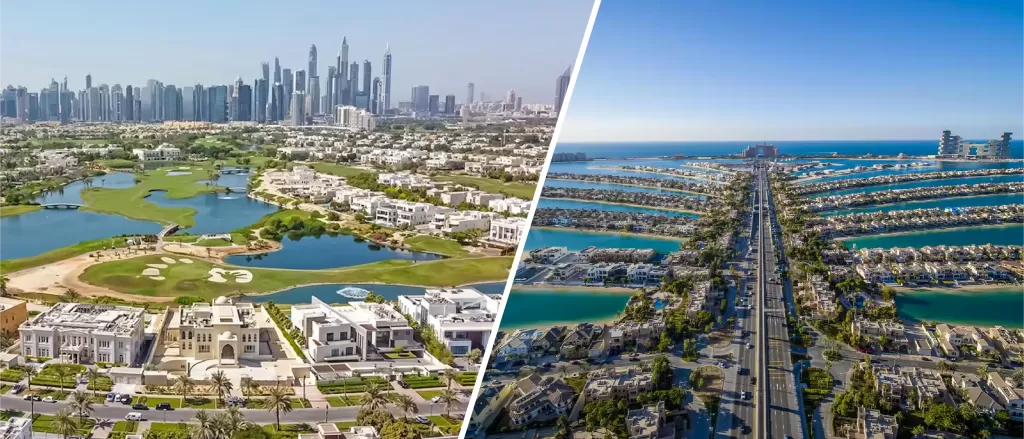
If you’re weighing Emirates Hills vs Palm Jumeirah 2026, the decision usually isn’t about “which is more luxurious.” Both sit at the top end of Dubai’s market, both are globally recognizable, and both attract buyers who want more than square footage. The real question is what kind of luxury you want to live inside every weekday: private estate calm, or waterfront destination energy.
Here’s the bottom line up front: Emirates Hills is designed for privacy, greenery, and villa-only living, while Palm Jumeirah is designed for a beachfront lifestyle with a more public-facing ecosystem—hotels, dining, promenades, and a broader mix of residences. Palm Jumeirah is master developed by Nakheel, while Emirates Hills is widely recognized as part of Emaar’s Emirates Living umbrella and is associated with elite, gated villa living.
This guide compares both communities through practical, real-life filters: lifestyle fit, liveability, ownership costs, privacy, and who each destination tends to suit best—end users, second-home owners, or investors.
The one difference that decides 80% of choices
If you remember one thing, make it this:
Emirates Hills = private, green, villa-only estate living.
Palm Jumeirah = beachfront, social, mixed residential + hospitality.
That single design intent shapes everything else: commute patterns, weekend traffic, how often you share your neighborhood with visitors, and what “convenience” means. In Emirates Hills, convenience often equals quiet roads, large plots, and controlled entry. On Palm, convenience often equals walkable dining, beach clubs, resort services, and sea-view routines.
Location and day-to-day connectivity
Emirates Hills is inland, gated, and closely linked to established residential districts and major road corridors. It’s commonly associated with golf-side living and a low-profile residential setting.
Palm Jumeirah is an offshore, man-made island extending into the Arabian Gulf and connected to the mainland via the trunk. It’s a master-planned coastal destination with residences, retail, leisure, and marinas.
A practical point: Palm has its own internal transit component—the Palm Monorail, which opened in 2009 and runs along the trunk (with stations connecting key points).
How this feels in real life:
Emirates Hills is typically straightforward for daily school runs and business commuting if your routine is car-based. Palm can be excellent for lifestyle access, but weekends and peak dining hours can create heavier traffic because the island is also a destination.
Lifestyle vibe: quiet estate vs destination island
Emirates Hills is often described as low-key luxury. It’s built around discretion, low density, and private homes—not public attractions. That matters if you prefer a neighborhood that doesn’t “host the city.”
Palm Jumeirah blends residential life with hospitality and tourism. Even if your building is calm, the island itself has energy—restaurants, hotels, beach venues, and seasonal peaks. If you enjoy stepping out into a vibrant scene, Palm can feel like a permanent staycation. If you want minimal public interface, Emirates Hills usually wins by design.
Property types: villa-only vs mixed inventory
This is a major divider.
Emirates Hills is known for villa-only inventory, often custom-built, with architectural variety, larger plot sizes, and layouts shaped by owner preferences rather than standardized templates. It’s also frequently described as one of Dubai’s most exclusive gated villa communities.
Palm Jumeirah offers a broader spectrum: villas (including frond villas), apartments along the trunk, and branded residences tied to hotel operators in parts of the island ecosystem. Nakheel highlights Palm Jumeirah as a master development hosting residences plus retail/leisure and marinas.
What this means for you:
If you want a villa no matter what, Emirates Hills keeps the search focused. If you want multiple entry points (apartment now, villa later—or an easier lock-up-and-leave), Palm has more flexibility.
Views + outdoor environment: golf-green vs sea-salt
Emirates Hills is defined by greenery, landscaped streets, and golf-side scenery. Many homes prioritize a “green + water” feel (lakes/fairways) rather than sea frontage.
Palm Jumeirah is about sea and marina views, shoreline routines, and a strong waterfront identity. The trade-off is practical: coastal homes face higher exposure to salt air and humidity, which can influence exterior maintenance rhythms.
This isn’t about better vs worse—it’s about what you want to see out of your windows and how you want your weekends to feel.
Amenities and daily convenience
In Emirates Hills, daily life is villa-centric: private gardens, pools, and a more residential rhythm. Many lifestyle amenities are nearby, but not “inside” the community as public destinations.
Palm Jumeirah, by contrast, layers residential life with hotel-grade amenities: waterfront dining, spas, beach clubs, retail nodes, and promenades. Nakheel positions the island as home to luxury residences plus leisure and marinas, which reflects this integrated ecosystem.
So the right question becomes: do you want your amenities mostly inside your home (villa living) or around your home (destination living)?
Privacy and the “public interface”
Both communities can be secure, but privacy works differently.
Looking for the perfect property? Contact us now for a free consultation!
Contact us via WhatsAppEmirates Hills is gated with controlled entry and low visitor foot traffic by design. Palm Jumeirah is partly residential and partly hospitality-driven, so public access points and high-traffic zones exist alongside quiet pockets.
If privacy is non-negotiable, Emirates Hills is usually simpler. If you’re happy with a more public-facing destination in exchange for the beach lifestyle, Palm still makes sense—especially if you choose micro-locations carefully.
Families: routines, space, and weekly rhythm
Emirates Hills often suits families who want predictable routines: low-density streets, large homes, space for home offices, and multi-generational living setups.
Palm Jumeirah can also work for families—especially if beach access is a daily priority—but routines can shift with seasonality. Weekends and holiday periods can bring more visitors, which changes traffic and noise levels in specific zones.
Here’s a quick “week test”:
- If you want quiet streets + stable rhythm, lean Emirates Hills.
- If you want beach-first routines + walkable dining, lean Palm.
Value, liquidity, and what “worth it” means at this tier
At ultra-prime levels, value isn’t only price per sq ft—it’s what the asset is designed to deliver.
Emirates Hills tends to behave like a trophy villa market: limited supply, villa-only positioning, high privacy. Palm can also be ultra-prime, but its wider product range creates more price bands and—often—more comparable inventory in certain segments.
If you’re investing, you’ll typically evaluate:
- End-user demand (how many buyers want to live here)
- Lifestyle branding (how global the address is)
- Resale liquidity (how easy it is to find a buyer at your target price)
Palm’s brand is extremely global; Emirates Hills is extremely exclusive.
Ownership costs: upkeep, service charges, coastal wear
Ownership realities differ by setting:
- On Palm, coastal exposure can increase exterior maintenance needs over time (salt + humidity).
- In Emirates Hills, costs are often scale-driven: landscaping, pools, large plot upkeep, and keeping a trophy villa at top condition.
Buyers commonly underestimate “ownership beyond the mortgage.” The best approach is to budget a realistic annual maintenance allowance and ask for community/building cost breakdowns early.
For transaction trust and compliance, always work with RERA-aligned processes and verify documentation via official channels.
Emirates Hills vs Palm Jumeirah comparison table
| Factor | Emirates Hills | Palm Jumeirah |
|---|---|---|
| Lifestyle | Ultra-private, residential, green | Resort-style, beachfront, vibrant |
| Property types | Villas only | Villas + apartments + branded |
| Outdoor feel | Golf/fairways, lakes, parks | Sea/beach, promenades, marinas |
| Privacy | Very high, gated, low tourism | Varies by zone; more public interface |
| Best for | Privacy-first end users | Lifestyle buyers + lock-up-and-leave |
| Connectivity | Car-centric routines | Road + monorail on trunk |
| Ownership realities | Plot/landscaping upkeep | Coastal wear + building/service costs |
How to decide with a simple framework
Use this 3-step method:
- Define the mission: primary home, second home, or investment?
- Rank non-negotiables: privacy, beach access, school routine, social life, building amenities.
- Shortlist by micro-location: on Palm, choose trunk vs fronds carefully; in Emirates Hills, compare plot orientation and golf/lake adjacency.
Then do the final check: “Will I love this home on a normal Tuesday?”
FAQs About Emirates Hills vs Palm Jumeirah
Emirates Hills is typically more private because it’s a gated, low-density villa community with minimal visitor traffic. Palm Jumeirah includes hospitality and public lifestyle zones, so privacy depends heavily on micro-location (fronds vs trunk) and building positioning near venues.
Palm Jumeirah offers more variety—villas, apartments, and branded residences—so it suits different budgets and use cases. Emirates Hills is villa-only, which is ideal if your non-negotiable is a standalone home, larger plot, and a quieter residential environment.
Often yes, especially for buyers who want lock-up-and-leave convenience, resort amenities, and waterfront routines. Branded residences and managed buildings can reduce day-to-day hassle. The right choice depends on whether you accept higher public activity during peak seasons.
Many families prefer Emirates Hills for stable routines, space, and privacy. Larger villas can suit multi-generational living, home offices, and domestic staff accommodation. Palm can still work well if beach access and outdoor activities are central to your family lifestyle.
Emirates Hills often feels simpler for car-based commuting because it’s inland and closely connected to major road corridors. Palm Jumeirah can be convenient for leisure along the beachfront corridor, but internal island traffic can rise on weekends and peak dining hours.
Yes. The Palm Monorail opened in 2009 and runs along the trunk with key stations serving major destinations on Palm Jumeirah. It’s useful for internal movement, while taxis/ride-hailing remain common for daily trips beyond the island.
Conclusion
In the Emirates Hills vs Palm Jumeirah 2026 decision, both communities deliver elite Dubai living—but they represent different definitions of luxury. Emirates Hills leans toward discretion, greenery, and villa-only privacy in a gated estate environment. Palm Jumeirah leans toward a waterfront lifestyle, resort convenience, and broader property options that can suit primary residents, second-home owners, and lifestyle-led buyers.
The smartest way to decide isn’t to pick “the best.” It’s to match the address to your normal week: school runs, commute style, social rhythm, and how much public energy you want around you. Then refine by micro-location—golf adjacency and plot orientation in Emirates Hills; trunk vs fronds and building positioning on Palm.
If you want a shortlist that fits your goal (family home vs second home vs investment), OPlus Realty can compare live inventory side-by-side and guide you through ownership costs, viewing strategy, and due diligence.